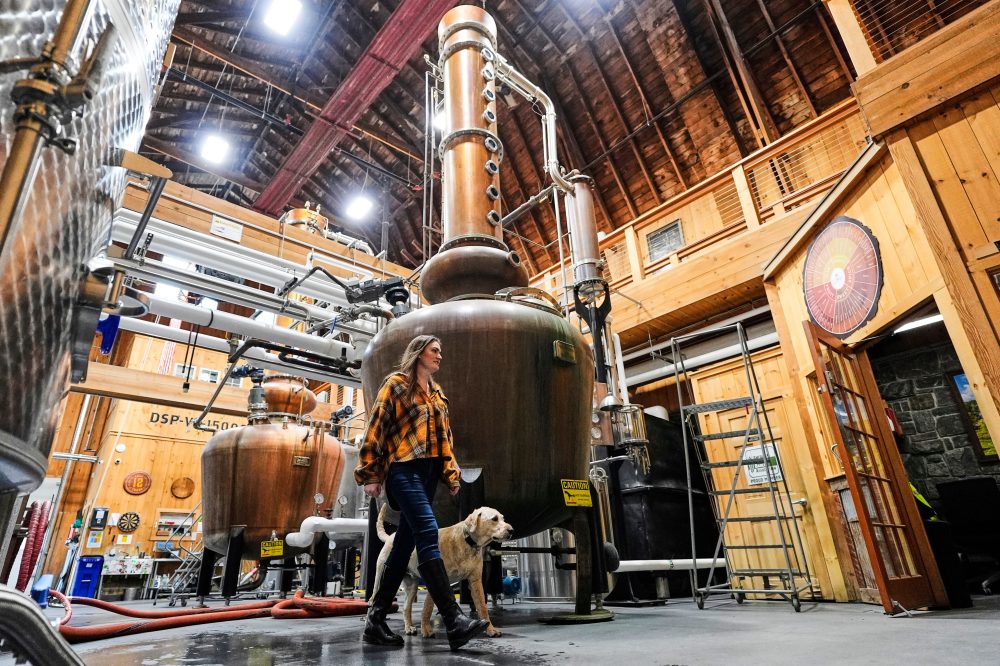

SHOREHAM, Vt. — As a college freshman studying chemical engineering, Meghan Ireland had always been passionate about chemistry but never imagined she could apply her scientific knowledge to crafting whiskey.
Everything changed when she discovered an article featuring a female chemical engineer who had become a master whiskey distiller. While her classmates pursued careers in plastics and pharmaceuticals, Ireland set her sights on the whiskey industry.
“It was kind of like a connection of, ‘hey, I can see someone who looks like me, who has the same exact kind of education and background doing this job,’ and kind of opened it up as an option,” said Ireland, who now serves as chief blender for Vermont’s WhistlePig whiskey brand.
Ireland represents a growing wave of women breaking into an industry historically dominated by men and not always open to newcomers. Female entrepreneurs are creating their own brands and pioneering innovative distilling and blending techniques as whiskey consumption among women continues to rise.
However, skepticism persists among some male peers and customers who question whether these women even enjoy drinking whiskey.
Becky Paskin, a U.K. journalist who founded the OurWhiskey Foundation to support women in the whiskey business, encountered this doubt while judging a whiskey competition.
“It is a drink that comes with certain expectations around which gender drinks it and which gender makes it,” Paskin explained. “Barely any other drink or food falls under such scrutiny.”
Part of Paskin’s mission involves creating appropriate imagery of women enjoying whiskey that avoids objectification or negative stereotypes.
“The only images of women drinking whiskey were depicting them as being pregnant, drunk, naked; or pregnant, drunk and naked,” she noted.
American whiskey production has traditionally been viewed as a man’s profession, associated with men savoring amber spirits in dimly lit, smoke-filled spaces. However, industry historians emphasize that women have always played crucial roles and were essential to the industry’s survival in America.
According to bourbon expert Susan Reigler, the earliest distilling equipment was invented by Maria Hebraea, a 2nd-century alchemist. Initially, distilling was considered women’s domain since they handled home brewing, medicine preparation, and household management.
During the 1800s in Kentucky, women operated distilleries, with Catherine Carpenter documenting the first recorded sour mash recipe, which became the standard American whiskey style. While women spearheaded the temperance movement in the 19th and 20th centuries, historian Fred Minnick’s book “Whiskey Women” suggests female bootleggers may have outnumbered males during Prohibition, partly because law enforcement was less likely to search women.
Reigler reflects on the remarkable transformation of the U.S. whiskey industry, which was struggling when she began covering it from Louisville, Kentucky, in the 1990s. As producers worked to revitalize American interest in whiskey, she documented women’s contributions, from distillery wives making crucial marketing choices that boosted tourism to female bartenders creating innovative whiskey cocktails.
The Kentucky Bourbon Trail, now replicated nationwide, was co-created by three women: Peggy Noe Stevens, the world’s first female Master Bourbon Taster at Woodford Reserve; Donna Nally from Maker’s Mark; and Doris Calhoun from Jim Beam, according to Reigler.
“There have always been women in bourbon,” she emphasized. “But a lot of them have been behind the scenes.”
At WhistlePig in Vermont, Ireland has maintained whiskey consistency since 2018 while overseeing experimental productions. Her debut innovation, Boss Hog VII, earned acclaim and awards for her decision to age it in Spanish oak and Brazilian teakwood barrels.
Ireland believes increased female participation helps establish whiskey as “a drink for everyone.”
“It can be enjoyed by everyone and it’s being made by females too,” she said.
After decades as a food industry executive, Judy Hollis Jones entered the whiskey world by launching a Kentucky company in 2019. The transition reminded her of corporate boardrooms where she was frequently the sole woman present.
Hollis Jones leads Buzzard’s Roost as president and CEO, a whiskey brand she co-founded with Master Blender Jason Brauner. She characterizes the whiskey business as challenging with ups and downs, but notes the steady increase in women attending tastings and tours, eager to explore whiskey culture.
“I’ve had people say to me, ‘Oh, well, you don’t wear jeans, boots and a cowboy hat,’” she recalled. “And I said: ‘No, I don’t. And every bourbon drinker female does not. We are very wide range of people that love bourbon.’”