
A six-story glass building nestled among hotels, spas and cafes in Manhattan’s Chinatown has become the center of a federal espionage case that began in Brooklyn court this week.
Federal prosecutors allege the unremarkable structure housed a covert Chinese police station designed to target and intimidate democracy advocates living in America, complete with signage reading “Fuzhou Police Overseas Service Station, New York USA.”
Defense attorneys for the accused operator, 64-year-old Lu Jianwang, argue the facility served as nothing more than a gathering place for Chinese-Americans to handle administrative tasks like driver’s license renewals during pandemic travel restrictions while enjoying recreational activities like ping-pong and mahjong.
Lu’s federal trial commenced Wednesday in Brooklyn, over three years since his arrest at his Bronx residence on allegations of conspiring to operate as an unregistered foreign agent and destroying evidence, including WeChat communications with an alleged Chinese government contact.
“Lu was living in New York City but he was working for the Chinese government,” prosecutor Lindsey Oken declared during opening arguments.
According to Oken’s statements, Lu and co-defendant Chen Jinping created the Chinatown facility in 2022 following Lu’s attendance at a Fujian province event where China’s Ministry of Public Security revealed plans for 30 clandestine police stations worldwide.
Oken explained to jurors that China’s communist leadership employs these stations to surveil individuals it “views as enemies of its interests.” She indicated that testimony will include a dissident who allegedly became a target of Lu’s operation.
The disputed Manhattan location operated within the same premises as the America ChangLe Association, a community group managed by Lu and his brother Jimmy that identified itself in tax documentation as a “social gathering place for Fujianese people.” Defense counsel noted that ChangLe translates to “eternal joy.”
While Oken conceded the organization openly provided driver’s license services, she emphasized such activities violated U.S. law without proper registration.
The prosecution contends Lu served Chinese interests “without asking or telling the U.S. government,” breaching the Foreign Agents Registration Act that mandates individuals representing foreign governments register with the Justice Department.
Defense lawyer John Carman characterized the proceedings as a routine administrative oversight rather than international espionage drama.
“Lu was arrested for essentially failing to file a form,” Carman informed the jury.
Carman’s opening statement emphasized that evidence will demonstrate Lu is “not a spy, not a part of Chinese intelligence services, not a part of the Chinese Communist Party, the CCP, and he’s not an agent of the Chinese government.” He referenced two concepts: “No good deed goes unpunished” and “Guilt by association.”
Following a tip from an organization tracking Chinese international suppression efforts, FBI agents conducted a comprehensive search of the alleged New York outpost on October 3, 2022, examining documents, forcing open secured storage areas and confiscating electronic devices, according to Carman.
“They turned the place upside down,” Carman described to jurors.
The following day, Oken stated, Lu acknowledged to federal agents that he created the Manhattan operation, maintained contact with his handler through WeChat and had erased those conversations. Carman noted that neither of Lu’s two-hour FBI questioning sessions were recorded. Authorities arrested Lu in April 2023.
Chen, Lu’s co-defendant, entered a guilty plea in December 2024 to conspiracy charges for acting as an unregistered foreign agent. He awaits sentencing following Lu’s trial while remaining free on bond.
Lu, also known as Harry Lu, sat Wednesday beside Baimadajie Angwang, a former NYPD officer who was exonerated three years ago of accusations that he served as a Chinese government “intelligence asset.” Angwang, currently pursuing legal action to return to police work, now assists Lu’s defense team as an investigator.
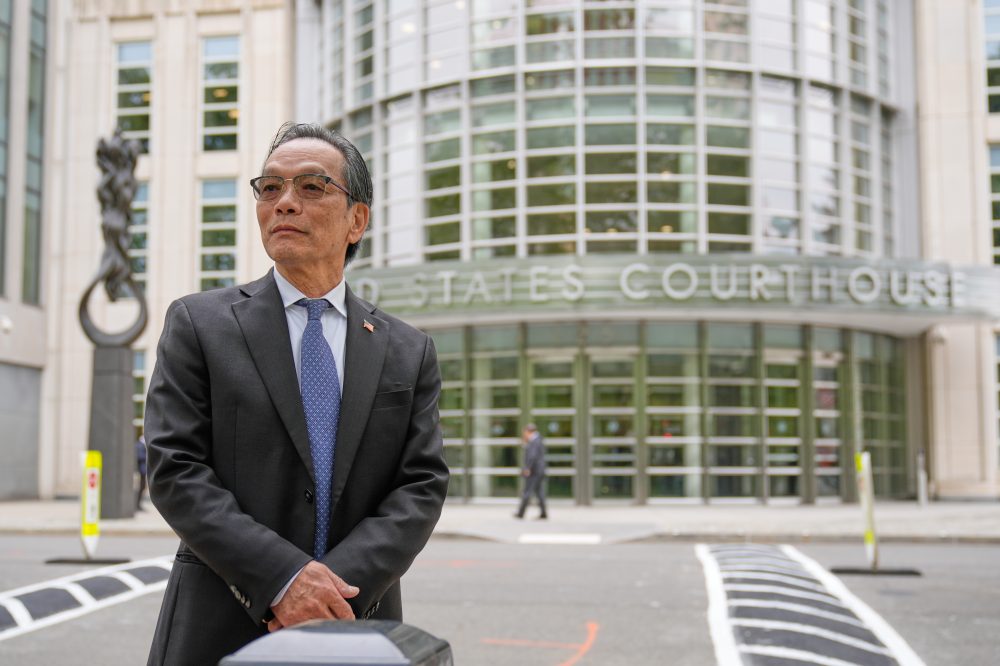
Dressed in a dark suit with a light blue tie and glasses, Lu relied on an interpreter who translated the proceedings into Fujianese through an earpiece due to his limited English proficiency. Both Lu and Angwang wore American flag pins on their clothing.
Dozens of supporters, including Lu’s fellow church members, demonstrated outside the courthouse with signs declaring “Justice for Harry Lu” and “Chinese Americans Are Americans!” while waving small American flags as Lu and his legal team arrived.
“No one controls him,” Carman told jurors. “If Harry Lu is an agent of anyone, he is an agent for his community — the local people in his community.”
“You have the life of an innocent man in your hands,” the attorney concluded.