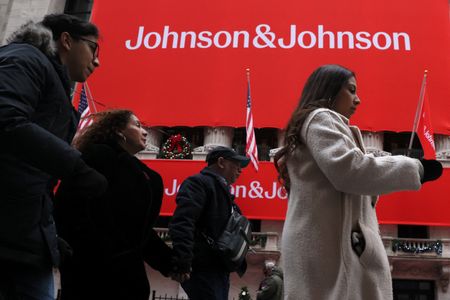

A federal judge in Manhattan has denied Bayer’s attempt to stop Johnson & Johnson from advertising claims about its prostate cancer treatment, ruling that the pharmaceutical giant failed to prove its case.
U.S. District Judge Dale Ho issued the Friday evening ruling, determining that Bayer could not demonstrate a strong likelihood of winning its lawsuit against J&J’s marketing campaign for the drug Erleada. The German company had argued that J&J’s promotional materials were causing significant damage and undermining confidence in Bayer’s competing medication Nubeqa.
The legal battle began on February 23 when Bayer filed suit, challenging J&J’s assertion that patients experienced a “51% reduction in risk of death” when treated with Erleada rather than Nubeqa. J&J claimed this finding came from research following “rigorous” Food and Drug Administration protocols.
Bayer contested the reliability of these comparative effectiveness claims, arguing that most Nubeqa patients in the study received off-label treatment. The company also questioned whether the FDA had properly reviewed J&J’s retrospective real-world data analysis as an alternative to standard clinical trials.
In his 41-page ruling, Judge Ho concluded that J&J’s promotional materials accurately reflected their research findings. He found that Bayer had not pointed to methodological flaws significant enough to render the New Brunswick, New Jersey-based company’s statements substantially false or deceptive.
“Based on the current record,” Ho stated in his decision, “the methodological choices made by the authors of the study were not errant or out-of-step within the relevant scientific community.”
Following the court’s decision, Bayer spokesperson Sue Ann Pentecost issued a response: “Bayer continues to believe the full body of evidence supports its false advertising claims and looks forward to the court’s determination on the merits of the case.”
Johnson & Johnson characterized the ruling as “a win for scientific exchange and a strong win for patients…. Real-world evidence helps clinicians make informed treatment decisions, especially when head-to-head clinical trials data are not available.”
The National Cancer Institute reports that approximately 313,780 American men received prostate cancer diagnoses in 2025, with 35,770 deaths attributed to the disease during that same period.
The financial stakes are substantial, with Nubeqa generating 2.39 billion euros ($2.81 billion) in sales during 2025, while Erleada recorded $3.57 billion in revenue.