
Federal authorities initiated legal proceedings Tuesday against Denver and its police force, challenging a prohibition on assault weapons that Colorado’s most populous city has maintained for more than three decades.
The legal challenge followed Denver leadership’s public refusal to comply with Justice Department demands to eliminate the local regulation that criminalizes possession of such firearms, which has been enforced since 1989.
The current Republican administration contends the prohibition infringes upon Second Amendment constitutional protections. Federal officials are also considering legal action against Colorado’s statewide restriction on high-capacity ammunition magazines, implemented after the 2012 Aurora theater tragedy.
“The Constitution is not a suggestion and the Second Amendment is not a second-class right,” acting Attorney General Todd Blanche said in a statement on Tuesday. “Denver’s ban on commonly owned semi-automatic rifles directly violates the right to bear arms.”
Justice Department representatives had contacted city leadership the previous week, requesting suspension of enforcement and proposing discussions to settle the dispute. However, during a Monday press briefing, Denver’s mayor and police commander firmly declined the federal request.
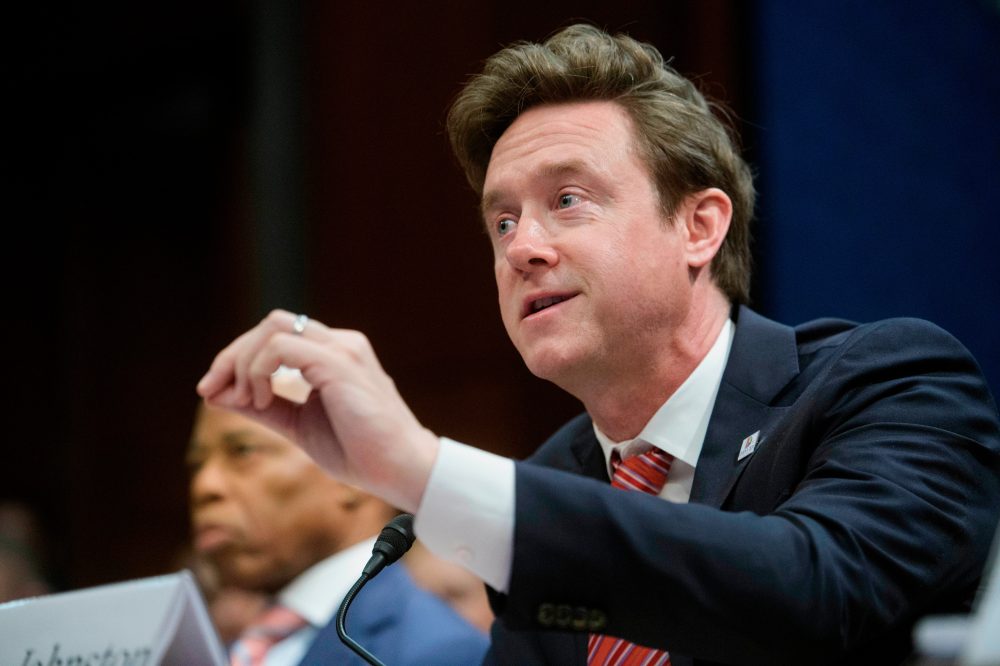
“Our answer is hell no,” Mayor Mike Johnston said. “No, we will not roll back a common sense policy that has kept weapons of war off of these city streets for 37 years. No, we will not put first responders at greater risk every time they respond to a dangerous incident No, we will not go back to a time when folks are worried about walking into movie theaters or grocery stores or public elementary schools.”
City officials implemented the weapons restriction during a time when gun violence concerns were particularly acute in the community.
Colorado has experienced multiple mass casualty incidents in subsequent years — including the 1999 Columbine High School tragedy that claimed 14 lives, the Aurora cinema shooting that resulted in 12 deaths and 70 injuries, a 2021 Boulder grocery store attack killing 10 people, and a 2022 incident at a Colorado Springs LGBTQ venue that left five dead.
Police Chief Ron Thomas noted he began his career with the department during the same year the weapons prohibition took effect, and credited the policy with helping combat gun violence. Among 2,100 firearms confiscated citywide last year, less than 2% were assault-style weapons, according to Thomas.
In their court filing, federal prosecutors stated Denver’s restriction encompasses AR-15-style rifles possessed by approximately 16 million Americans nationwide. Government lawyers characterized these as “ordinary semiautomatic rifles” utilized for legitimate activities, “including but not limited to self-defense.”
Justice Department lawyers have raised comparable objections to Colorado’s high-capacity magazine restrictions, which the state’s highest court validated in 2020. In correspondence dated April 28 to state leadership, the administration warned of potential litigation unless enforcement ceases and officials acknowledge the law’s unconstitutionality.
“Law-abiding Americans own literally hundreds of millions of magazines identical to those banned in Colorado,” Assistant Attorney General Harmeet Dhillon wrote.
Colorado’s top legal officer Phil Weiser responded that firearms equipped with high-capacity magazines pose significant public safety risks. In his statement, Weiser defended the restriction as appropriate.
“Large-capacity magazine laws are responsible policies that decrease the deadly impacts of mass shootings and save lives,” he said.