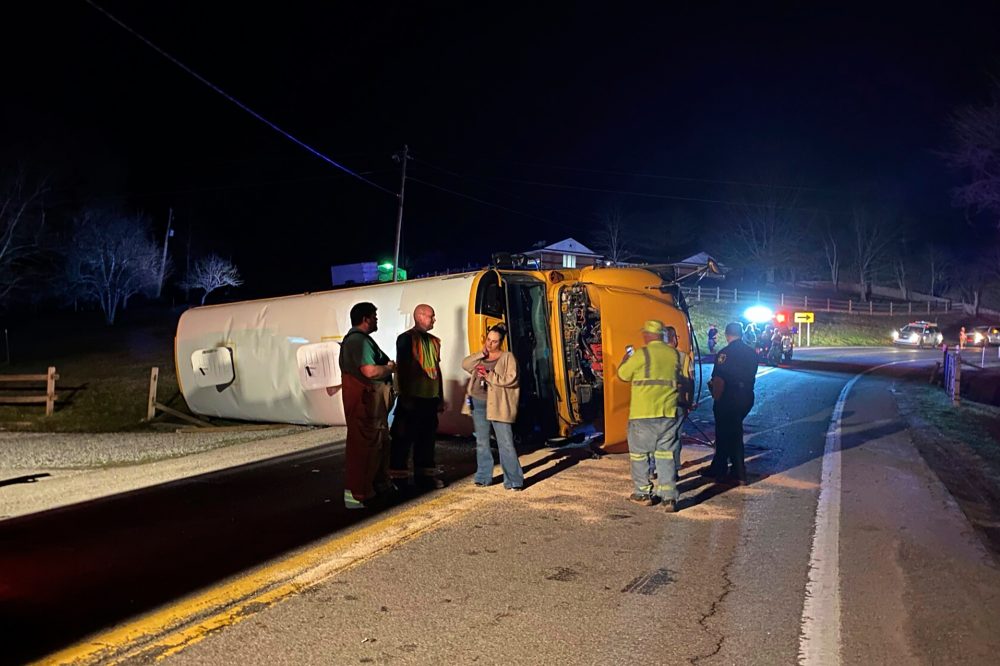

Federal safety officials are calling for mandatory alcohol detection technology on all new school buses following a devastating crash in West Virginia that left one student with an amputated leg and two others seriously hurt when their intoxicated driver lost control of the vehicle.
The National Transportation Safety Board issued its first-ever recommendation Thursday for alcohol detection systems that would prevent school buses from starting if the driver shows signs of impairment. The move comes after investigators found that impaired school bus drivers represent a more widespread issue than initially understood.
“There’s a higher expectation for school bus drivers than many other types of drivers,” explained Kris Poland, deputy director of the NTSB’s Office of Highway Safety. “We expect that the drivers are attentive, not fatigued, not impaired and are driving as safely as possible.”
The safety board did not provide cost estimates for installing such systems or identify who would cover the expenses. Similar ignition interlock devices required for DUI offenders typically cost between $75 and $150 for installation, plus approximately $100 monthly for monitoring services.
Implementation would require action from federal regulators or state governments, though Congress would need to pass legislation for nationwide adoption. The recommendation targets alcohol specifically rather than other substances because investigators determined alcohol caused the West Virginia incident, and reliable testing methods for drugs like marijuana are not yet available.
This recommendation builds on a previous NTSB proposal that Congress approved requiring alcohol detection systems in all new passenger cars, though that rule remains stalled in the regulatory process.
Drunk driving concerns have long troubled the NTSB, as alcohol contributes to roughly one-third of the approximately 37,000 annual traffic fatalities. While investigators could not establish precise statistics on impaired school bus drivers, they discovered sufficient evidence to justify the new safety measures.
Federal highway safety agencies do not maintain separate records for school bus driver DUIs versus other commercial drivers, and data often excludes incidents that do not result in fatal crashes. However, a 2020 Stateline.org investigation revealed at least 118 school bus drivers faced drunk driving accusations over a five-year period, according to Meg Sweeny, lead author of the NTSB’s West Virginia crash report.
In that tragic incident, the driver veered off a rural road after striking a driveway culvert, injuring all 19 children on board. While most students sustained minor injuries, the driver received a prison sentence of up to 110 years last year.
Peter Kurdock, general counsel for Advocates for Highway and Auto Safety, expressed alarm at the number of impaired driving cases among bus drivers, despite representing a small fraction of all drivers.
“Children going to and from the schoolhouse are America’s most precious passengers,” Kurdock stated. “So we should be doing all we can to make the bus as safe as possible.”
Kurdock anticipates resistance from owners of the nation’s half-million school buses, similar to industry opposition to the NTSB’s ongoing recommendation for seat belts on school buses.
While several states have mandated seat belts, most school buses lack them partly because the vehicles are considered relatively safe. Even when seat belts are installed, the NTSB noted that students may not use them, prompting an urgent recommendation last fall following a Texas crash for districts to ensure proper usage.
The three largest school bus companies operating approximately 80,000 buses daily, along with major bus manufacturers, did not respond to requests for comment on the NTSB recommendation. The National School Boards Association also had no immediate response.
The NTSB emphasizes that most school bus transportation remains safe. According to the National Highway Traffic Safety Administration’s latest data, of nearly 1,000 fatal crashes involving school buses in the decade leading to 2023, 70% of the approximately 1,100 deaths occurred in other vehicles rather than on the buses themselves.
Only 113 school bus passengers died during that timeframe, demonstrating the general safety of these large yellow vehicles as long as children remain properly seated. The NTSB believes installing seat belts and ensuring their use would significantly improve safety outcomes.
New York attorney Todd Spodek, whose firm has handled thousands of drunk driving cases, does not believe the recommendation would infringe on bus drivers’ rights. He sees no viable argument that alcohol screening would be excessively burdensome for drivers.
“If you’re in a position of control of something like that, you should be held to a higher scrutiny,” Spodek noted. “It’s a minor inconvenience with a tremendous upside.”