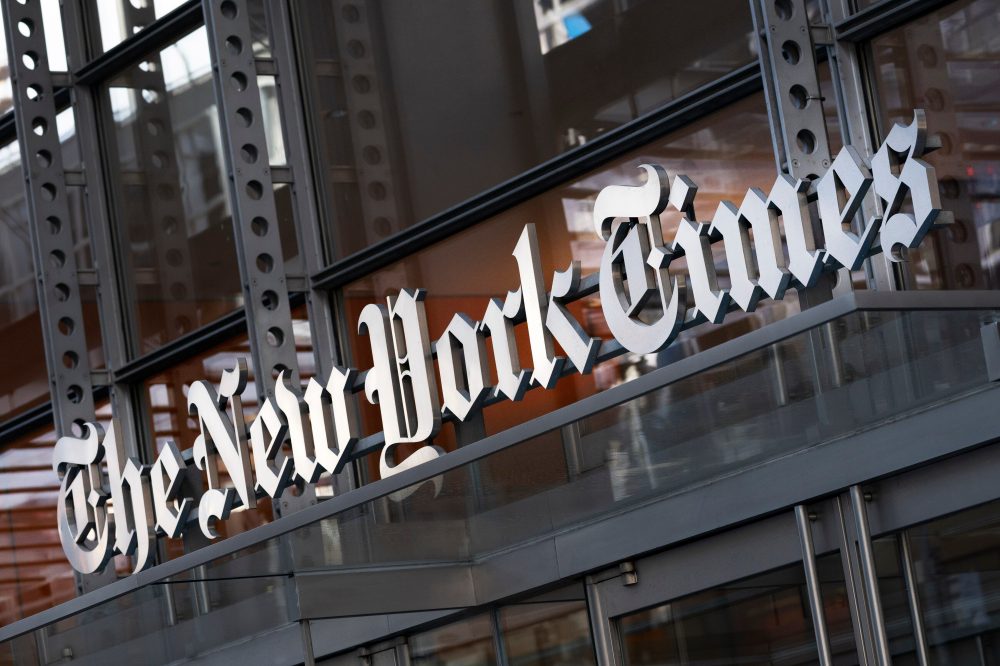

NEW YORK — Federal civil rights officials filed a discrimination lawsuit Tuesday against the New York Times, alleging the newspaper overlooked a white male staff member for advancement to boost diversity within its leadership structure.
The newspaper dismissed the legal action as having political motivations and stated it plans to mount a strong defense.
The Equal Employment Opportunity Commission brought the case on behalf of a Times editor who filed a complaint after being denied the deputy real estate editor position in 2025. The lawsuit alleges violations of Title VII of the 1964 Civil Rights Act, which bars workplace discrimination based on sex, race, national origin or religion.
According to the EEOC, the publication’s publicly announced objectives to expand diversity in management positions led to the white male candidate being eliminated from final interviews, while three female candidates and one Black male candidate advanced.
EEOC Chair Andrea Lucas, a Republican appointee, has actively supported the Trump administration’s efforts to challenge corporate diversity initiatives that she contends discriminate against white men and other groups. Last December, Lucas used social media to encourage white men to file complaints if they felt victimized by their employer’s diversity practices.
“No one is above the law — including ‘elite’ institutions. There is no such thing as ‘reverse discrimination;’ all race or sex discrimination is equally unlawful, according to long-established civil rights principles,” Lucas stated. “No matter the size or power of the employer, the EEOC under my leadership will not pull punches in ensuring evenhanded, colorblind enforcement of Title VII to protect America’s workers, including white males.”
New York Times spokesperson Danielle Rhoades Ha criticized the EEOC for departing from typical procedures in extraordinary ways. She noted that while the complaint focuses on a single staffing decision among more than 100 deputy roles throughout the newsroom, the federal filing makes broad accusations that disregard facts to support a preconceived conclusion.
“Neither race nor gender played a role in this decision – we hired the most qualified candidate, and she is an excellent editor,” Rhoades Ha stated.
The federal lawsuit, filed in U.S. District Court for the Southern District of New York, describes the unnamed complainant as a Times editor employed since 2014, primarily serving as a senior staff editor covering international news with prior real estate reporting experience.
The legal filing asserts that the woman selected for the deputy real estate editor role “did not have experience with real estate journalism” but “as a multiracial female, this candidate matched the race and/or sex characteristics NYT sought to increase in its leadership.” The EEOC noted that one interviewer characterized her as “a bit green overall.”
The commission’s lawsuit heavily referenced the Times’ diversity and inclusion initiatives as proof of discriminatory practices.
Specifically, the legal action highlights the newspaper’s “Call to Action” strategy released in February 2021, which established a target of boosting Black and Latino leadership representation by 50% before 2025. While the Times achieved this objective in 2022, it maintained its diversity commitments. Legal documents indicate that in 2024, white staff members comprised 68% of leadership positions, while people of color held 29%.
Lucas has repeatedly criticized representation targets that numerous corporations announced publicly, especially following the 2020 civil unrest after George Floyd’s death at the hands of police.
Title VII generally prohibits employers from considering race or gender in hiring, promotion, and employment decisions. Lucas has targeted practices she believes force managers to factor in these characteristics, including certain bias training programs and requirements for diverse candidate pools. Opponents argue the EEOC is undermining established practices meant to create equal opportunities for workers historically facing workplace discrimination.
In February, the EEOC disclosed an investigation into Nike for alleged racial discrimination against white workers. Unlike the Times case, the Nike probe originated from Lucas herself through a “commissioner’s charge” rather than an employee complaint, examining various diversity policies at the athletic apparel company.