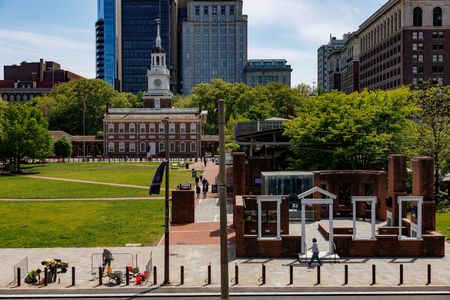

New historical panels went up overnight at George Washington’s former Philadelphia home Wednesday, as the Trump administration moved quickly after a federal appeals court cleared the way for changes to how slavery is portrayed at the national landmark.
The Department of the Interior defended the updated displays, saying they provide historical context for the President’s House and other sites within Independence National Historical Park. However, Philadelphia Mayor Cherelle Parker sharply condemned the move.
“Overnight, under the cover of darkness, the federal government removed panels at the President’s House that told a thorough history of Philadelphia,” Mayor Parker said in a statement.
Parker added that the Democratic-led city intends to pursue a rehearing on the legal questions surrounding the case.
Last month, a federal appeals court reversed a lower court ruling that had blocked the Trump administration from replacing the existing slavery exhibit at Independence National Historical Park.
The newly installed panels still include references to slavery and to those enslaved by George Washington, but several prominent headings from the previous exhibit were removed. Among those dropped was the heading “The Dirty Business of Slavery.” In its place, the new panels carry the title “Celebrating Independence Throughout the Years.” A map showing slave trade routes was also left out of the updated display.
“These new panels are full of historical context and highlight the momentous events that took place in the President’s House and the other sites at Independence National Historical Park,” the Department of the Interior stated, adding that the panels “acknowledge the evils of slavery.”
The changes drew concern from Alan Spears, senior director for cultural resources at the National Parks Conservation Association.
“This appears to be an effort to soften or sanitize the way the history of slavery is interpreted at Independence National Historical Park,” Spears said. “And I have grave concerns about how this impacts the ability of our national parks to fulfill their role as honest brokers of our shared national narrative.”
The exhibit change is part of a broader pattern during President Trump’s second term. His executive orders and declarations have led to the removal of slavery exhibits, the return of Confederate statues, and other actions that civil rights advocates argue could roll back decades of social progress and diminish recognition of key chapters in American history. Trump has stated his goal is to eliminate what he calls “anti-American” ideology.
The White House has also taken aim at the Smithsonian Institution over its historical presentations. Groups including the Organization of American Historians have spoken out against Trump’s actions, arguing they serve a political agenda rather than historical accuracy.
Trump has faced widespread criticism from civil rights organizations for invoking “reverse discrimination,” for claiming that civil rights policies have harmed white Americans, and for suggesting that museums place too much emphasis on “how bad Slavery was.”