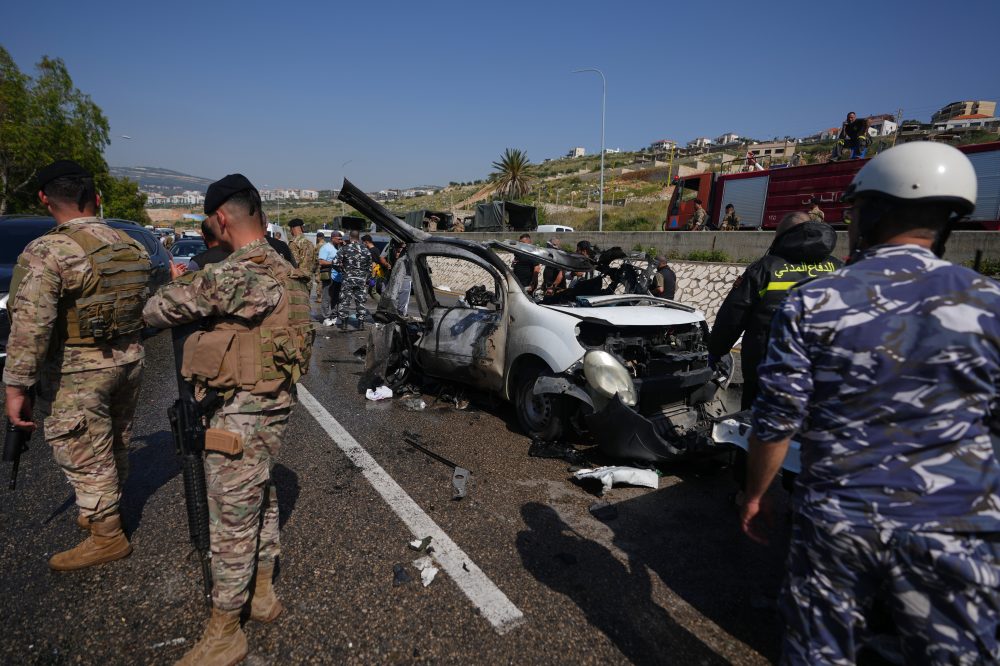

BEIRUT — Saturday’s deadly Israeli military operations resulted in 17 fatalities across Lebanon, with drone attacks targeting vehicles south of Beirut claiming four lives and separate airstrikes in the country’s southern region killing at least 13 others, according to state media and Health Ministry reports.
The vehicle-targeting drone operations south of Lebanon’s capital represent a significant escalation in hostilities, occurring despite a ceasefire agreement between Israel and Hezbollah that took effect on April 17. Despite the truce, both sides have maintained daily military operations.
Earlier this week on Wednesday evening, Israeli warplanes conducted an airstrike on a southern Beirut suburb, with Israel claiming the operation eliminated a high-ranking Hezbollah military commander. That attack marked the first strike near the capital since the ceasefire agreement was established.
Saturday’s drone operations included two strikes along the major highway connecting Beirut to the southern coastal city of Sidon, injuring several individuals, while a third attack occurred on a roadway leading to Lebanon’s Chouf region, resulting in three deaths, the state-operated National News Agency reported.
An Associated Press correspondent at one scene observed a fatality on the highway in Saadiyat.
Health Ministry officials confirmed that an Israeli airstrike on Saksakiyeh village in southern Lebanon resulted in at least seven deaths, including one child, with 15 people wounded. Ministry representatives noted this represented preliminary casualty figures.
Additional strikes hit various southern Lebanese communities, including an attack on Bourj Rahhal village that killed three people and another in Maifadoun that claimed one life, according to agency reports.
In a particularly tragic incident, Health Ministry officials said three Israeli drone strikes killed a Syrian man traveling by motorcycle with his 12-year-old daughter in Nabatiyeh city.
According to ministry accounts, following the initial attack, the man and his daughter managed to escape the immediate area before being targeted again by the drone, instantly killing the father. The wounded girl then moved approximately 100 meters away before being struck a third time by the drone. The child later succumbed to her injuries at a medical facility, NNA reported.
“The Ministry of Public Health denounces this barbaric targeting and the deliberate violence against civilians and children in Lebanon,” ministry officials stated, describing the attack as part of an ongoing pattern “of grave violations of International Humanitarian Law.”
Israeli military representatives reported that Hezbollah launched explosive drones into Israeli territory near the Lebanese border, with three soldiers wounded in one attack, including one seriously injured. Military officials added that Hezbollah also deployed drones within Lebanese territory, with one striking an Israeli vehicle without causing casualties.
Hezbollah acknowledged responsibility for multiple attacks within Lebanon and confirmed firing a drone at an Israeli military installation in the northern community of Misgav Am.
The current conflict between Israel and Hezbollah commenced on March 2, when Hezbollah launched rockets into northern Israel, occurring two days after the United States and Israel initiated military action against Hezbollah’s primary supporter, Iran. Israel has subsequently conducted hundreds of aerial bombardments and launched a ground offensive into southern Lebanon, seizing control of numerous border towns and villages.
Subsequently, Lebanon and Israel engaged in their first direct negotiations in over thirty years. The two nations have remained technically at war since Israel’s establishment in 1948.
A new round of diplomatic discussions is planned for Washington beginning Thursday and continuing for two days.
A 10-day ceasefire announced in Washington became effective on April 17, with the agreement later extended for an additional three weeks.
In Syria’s capital Damascus, Lebanese Prime Minister Nawaf Salam conducted discussions Saturday with Syria’s interim President Ahmad al-Sharaa, focusing on strengthening bilateral relations and enhancing security cooperation amid regional conflicts.
Addressing reporters before returning to Lebanon, Salam stated that Lebanon would not again be utilized to harm “our Arab brothers, on top of them Syria.” The Prime Minister was making an indirect reference to Hezbollah’s participation in Syria’s civil conflict that began in 2011, supporting the five-decade Assad family regime that concluded in December 2024.