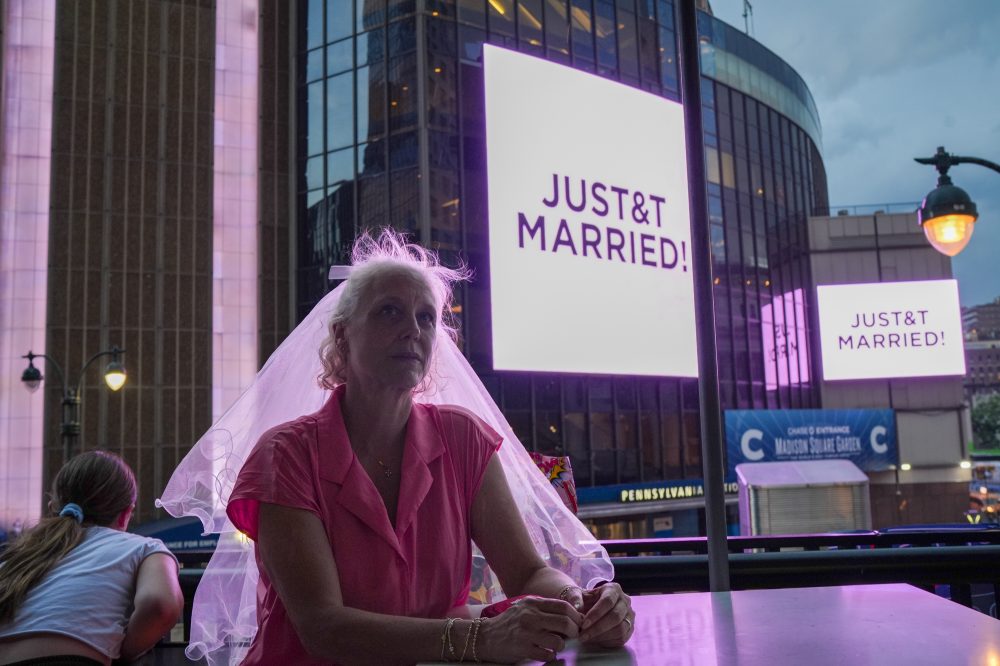

Justin Gignac showed up in a wedding tuxedo, trash-grabbing claw in hand, wading through crowds of Taylor Swift fans who had spent hours waiting outside Madison Square Garden. He was on the hunt for friendship bracelet beads — a meaningful keepsake in the Swift fan community. He came up empty on that front.
What he did find: a single AirPod, a ring pop, an ovulation test strip and a rainbow fan, among other discarded items. He packaged each piece into tiny one-inch boxes and sold them online. Fifty of those little collections of street debris were snapped up by Swift fans as far away as Australia, Germany and the United Kingdom.
“People were like, ‘Is there any more? Is there any more?’” he recalled.
In the days following what many have dubbed “the United States’ royal wedding,” fans combed Manhattan’s streets and the internet for any trace of the event. Despite it being a massive, star-studded gathering of roughly a thousand people, Swift managed to keep nearly every detail under wraps.
For close to twenty years, Swift has built her career on turning private experiences into shared ones — crafting songs that felt like entries from a personal diary, because sometimes they were. But her own wedding has become notable for what she has chosen to keep to herself.
A full week after the ceremony, not one confirmed photo had emerged showing the inside of the venue, the wedding ceremony itself, or Swift’s gown. Attendees and staff were required to sign strict non-disclosure agreements and hand over their cell phones. The couple arranged for street closures and surrounding tent walls to shield the celebration from outside view.
Some New York City residents expressed frustration over the security measures, which disrupted access to a major transit hub during a holiday weekend — all in the middle of a heat wave. The elaborate privacy effort also highlighted how, at Swift’s level of fame, genuine privacy demands a degree of wealth and influence that very few people possess.
Still, fans in Swift merchandise crowded the barricades, watching a steady stream of black SUVs roll into the arena.
In the early morning hours, a bakery van pulled up outside. A catering worker offered a box of apple honey pastries, which a police officer then distributed to fans waiting outside. One person in the crowd could be heard shouting: “Oh my God, you guys, we’re having Taylor Swift’s dessert!”
Gignac has spent 25 years turning New York City trash into collectible art, creating limited-edition sets from major city moments — like the Knicks parade — where the discarded objects themselves tell the story of a gathering. Swift’s wedding, he said, was a different kind of challenge.
“I was like, OK, let me see how close I can get,” he said. “Everything going on on the block outside of Madison Square Garden was a part of the festivities as well — it’s just a very different part.”
The area outside the venue was “fairly clean,” he noted, but he gathered enough to work with. He even tied discarded straws into knots to, as he put it, “reinforce the wedding theme.”
Fans who later saw the boxes told him the project brought to mind Swift’s song “New Year’s Day” — a track about lingering after a party ends and holding onto whatever is left behind.
“You’ve never had a song change your life, and the artist be the soundtrack of your life?” Gignac said. “That’s such a massive role in your day to day — it’s nice to have something from that.”
The absence of real photos left a gap that was quickly filled with artificial intelligence. Fake images of Swift and Kelce in wedding attire began circulating online, along with fabricated glimpses of the so-called “secret garden” that guests had described — an interior transformation of the arena featuring greenery, trees and flowers.
Some of the AI images were clearly meant as jokes, with users inserting themselves into the scene or pretending they had been hired as photographers. Others were crafted to appear genuine — blurry, pixelated shots meant to look like they had been secretly taken inside the venue.
Swift fans are well-known for hunting down hidden clues and “Easter eggs” in her music and social media posts. Longtime fan Alexa Volland said those same sharp-eyed habits helped many quickly identify AI-generated fakes by spotting distorted facial features, physically impossible dress details and hidden watermarks from tools like Google DeepMind’s SynthID.
“They built a habit of close observation,” Volland said.
Volland, who works as a video producer for the News Literacy Project, said she was surprised no real images had leaked — but was glad Swift maintained control over her own story.
“As a Swiftie, I would prefer to have those first looks come directly from her,” she said. “I know that we will eventually get a song that is probably the most revealing, way more revealing than any AI-generated image ever made.”
Boston-based Swift fan Margaret Willison said she was still waiting on one specific detail from the wedding.
“I need to know what her first song was,” she said. “It’s been haunting me.”
Willison, who has led workshops on Swift’s music and fan culture, said this kind of anticipation is central to Swift’s appeal. She has a rare ability to take seemingly small moments and turn them into something larger — “a cathedral we all get to be part of,” as Willison described it.
Willison said many fans trust that Swift will eventually share whatever she wants them to know, on her own terms.
“We don’t want something that’s been stolen from her,” she said.
Years ago, Swift sang about stepping away from the spotlight and choosing “the rose garden over Madison Square.” In the end, Willison said, it turned out those two things were not mutually exclusive.
“In all of her previous relationships, there was this tension between how much she was able to shine and still be understood by a partner,” Willison said. “Isn’t it incredible that she found that she didn’t have to choose?”