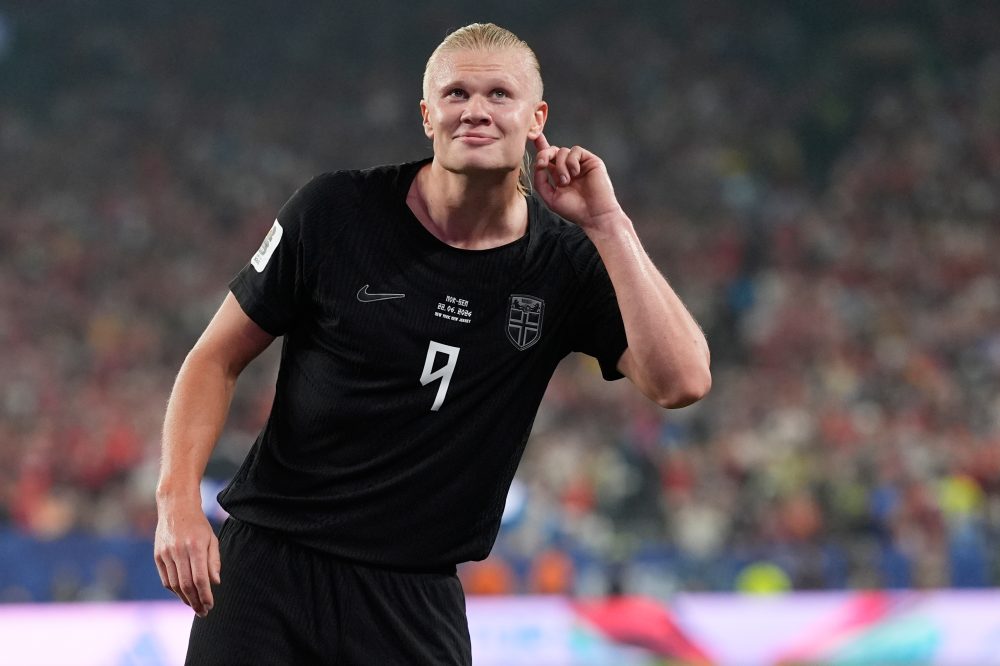

At 6 feet, 5 inches tall, Erling Haaland cuts an imposing figure on the soccer field — a towering presence who can make opponents look small in both size and ability. With seven goals scored across four World Cup matches heading into Saturday’s game, the Norwegian striker has earned comparisons to a machine. But among a growing wave of devoted new fans, he’s something else entirely: a babygirl and a princess.
Haaland has exploded into a full-blown social media sensation, with his own posts and fan-created memes converting casual observers into passionate supporters almost overnight.
His commanding physical presence paired with a surprisingly playful online personality has fueled the frenzy. Fans can’t stop talking about his flowing blond hair, color-coordinated hair ties, and lighthearted posts — including a Snapchat-filtered selfie where he declared Shrek his “twin.” The sharp contrast between his on-field dominance and his relaxed, self-deprecating internet personality has earned him the “babygirl” label, a term fans often apply to male celebrities or characters who come across as sensitive, caring, or vulnerable.
Haaland’s crossover appeal reflects a wider trend of soccer players becoming pop culture icons, driven largely by how they carry themselves away from the game.
Sarah Wilson, a 31-year-old baseball content creator based in New York, only recently started following soccer — but she’s become such a devoted fan over the past month that she went on an extended search to track down her new favorite player’s jersey.
“I love Erling Haaland more than life itself,” Wilson said in a video that has since gone viral. “I cannot fathom being such a pretty Norwegian princess and also being one of the best strikers in all of football.”
Haaland is riding a wave of fame even greater than what he’d already built as the Premier League’s leading scorer. Wilson says it comes down to the combination of extraordinary talent and an endearing personality.
“Him being really, really talented — that’s the first pillar of it all. And then you find out that he’s 25 years old and he’s probably the most Gen Z athlete in the World Cup,” Wilson told the Associated Press, pointing to his use of Snapchat and playful photo filters. She added that many new fans are thinking, “‘Wow, I love that guy, he’s hilarious. Now he’s my new favorite player,’ which is exactly what happened with me.”
Haaland’s animated reactions during matches and his distinctive look have inspired hundreds of memes. He’s embraced the attention, posting cheeky selfies on Instagram, sharing long-form vlogs on YouTube, and engaging with followers through his public Snapchat stories — frequently poking fun at himself in the process.
After netting two goals to eliminate Brazil from the tournament, he shared a smug locker room selfie with the caption, “Well well well.” When an Instagram video with close to 100 million views compared his appearance to a green onion — its stringy roots serving as a stand-in for his hair — Haaland fired back in the comments with a side-eyeing dog GIF. And when Google added a Viking rowing animation to his search results, he posted on X: “One thing to do today… search my name on Google,” complete with a winking emoji.
At a team news conference on Thursday, Haaland said he’s genuinely enjoyed the embrace he’s received from American fans.
“I think it’s a good thing because I like the Americans. I think they are kind of hilarious as well. They are funny. I like the way they are,” he said. “I think it’s just good and honestly, on every single thing, the World Cup so far here has been amazing.”
Sports function as a “cultural force” comparable to politics or religion, according to Jeffrey Kassing, a professor at Arizona State University who has spent years studying how fans and athletes use social media. He said it makes perfect sense that Haaland has “crossed over” into audiences with no prior interest in soccer. A song from his childhood has gone viral online. A lookalike competition is being organized. Even dogs have been spotted wearing blond wigs in his honor.
“There used to be a whole lot of gatekeeping that would happen with athletes; you would only ever hear from athletes maybe in an interview or in a press conference,” Kassing said. He noted that Haaland is a prime example of how today’s players have far greater control over how they’re perceived by the public.
The closeness fans feel toward athletes like Haaland is rooted in what researchers call a parasocial relationship — a one-sided connection where fans feel they know a celebrity personally, even though that celebrity doesn’t know them. Gayle Stever, a professor at Empire State University who has studied celebrity-fan dynamics for decades, noted that Haaland’s nearly 60 million Instagram followers feel a personal bond with him, despite the relationship being entirely one-directional.
The vast majority of these parasocial connections are “positive, healthy and normal,” Stever said, with only a small fraction of people taking things to unhealthy extremes.
Skyla Clarke, a 19-year-old sports management student in Brisbane, Australia, and a lifelong soccer fan, says she’s witnessed the darker side of fan culture — attacks on players after poor performances, and unprovoked hostility directed at athletes’ partners are not uncommon. Haaland himself described AI-generated content involving players as “a bit scary,” though he noted in Norwegian that the widespread attention on the team and its traditions — such as the rowing celebration — is ultimately a form of praise.
“Usually if it’s like that, it means that you’re doing something right, and that your country is doing something right,” Haaland said.
Even healthy fan behavior can seem strange to those unfamiliar with internet culture. Haaland isn’t the only player whose persona has taken off online, nor is he the only one fans have crowned a babygirl.
Fans have described feeling “maternal” toward Luka Modrić — particularly following Croatia’s elimination in what was the 40-year-old’s final international match. Clarke called Modrić a “special case,” saying his difficult childhood during the dissolution of Yugoslavia adds emotional depth to how fans connect with him online. Some fans incorporate childhood photos of him into their content, creating “a deeper appreciation for him as a player,” she said. Clarke’s own TikTok video about Modrić’s possible retirement racked up hundreds of thousands of views within days.
While Modrić maintains a relatively quiet social media presence compared to Haaland, Kassing noted that fans “take it upon themselves to try to shape the perception” of athletes they feel connected to. In both Modrić and Haaland’s cases, some fans do this by adding bows and hearts to images of the players.
Ahead of Norway’s quarterfinal matchup against England on Saturday, fans have also zeroed in on Haaland’s friendship with English player Jude Bellingham, his former teammate. Some fans have “shipped” the two, creating edits of them hugging and celebrating together and drawing comparisons to the TV show “Heated Rivalry,” in which two rival professional hockey players develop a romance away from the ice.
“People have been saying ‘heated Haalandry,’” said Nulara Ratwatté, a 19-year-old art student at the University of Melbourne, who is among the many fans whose videos about falling for Haaland have gone viral.
Ratwatté admits she’s “not supposed to talk about football” given her limited knowledge of the sport, but she says there’s no turning back after catching Haaland fever. She describes him as a “big, friendly giant” and, despite knowing little about soccer, she’s now tuning in to root for Norway.
“Truly, from the bottom of my heart,” she said, “I love him.”