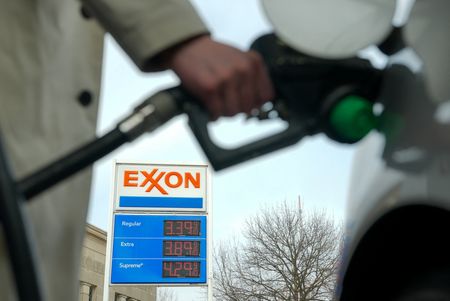

Energy giant Exxon Mobil Corporation exceeded Wall Street expectations for first-quarter profits on Friday, despite facing substantial losses from Middle East conflict disruptions and complex financial timing issues.
The oil company reported adjusted earnings of $1.16 per share for the January-March period, surpassing analyst predictions of $1.00 per share compiled by LSEG. However, the company’s overall net income fell to $4.2 billion, a significant drop from $7.7 billion during the same quarter last year, marking the weakest performance since early 2021.
The adjusted earnings figure excludes a substantial $700 million loss from oil shipments that couldn’t be delivered due to the ongoing U.S.-Israeli conflict with Iran. When also removing impacts from financial derivatives, earnings would have reached $2.09 per share.
Exxon’s operations were helped by rising oil prices and stronger output from key production sites in the Permian Basin and Guyana, which partially compensated for Middle East production setbacks.
Company CEO Darren Woods acknowledged the challenges in a statement, noting that while Exxon has grown stronger in recent years, “events in the Middle East tested that strength with the safety of our people remaining our top priority.”
The Middle Eastern crisis has pushed oil prices upward since late February, though the impact on major oil companies’ profits has varied significantly across the industry.
Exxon had previously revealed it expected multi-billion-dollar impacts from timing effects that should reverse in coming quarters. This contrasts with British oil giant BP, which reported improved profits this week thanks to successful oil trading activities.
The company employs financial derivatives to protect against price fluctuations during the time needed to deliver oil shipments to customers. Since the physical shipment value isn’t recorded in earnings until transactions complete, this creates timing gaps, according to company explanations.
“In general, it takes a few months for that to unwind,” Chief Financial Officer Neil Hansen explained during an interview. He noted the difficulty in forecasting future timing effects, which depend on commodity price movements.
Hansen emphasized that the core business showed resilience, with net income actually growing year-over-year when excluding timing impacts and undelivered shipments.
Approximately 20% of Exxon’s oil and gas production occurs in the Middle East, representing one of the highest regional exposure levels among major competitors. By comparison, Chevron, America’s second-largest oil producer, reported Friday that less than 5% of its production comes from the Middle East.
War-related disruptions reduced Exxon’s first-quarter production by 6% compared to the previous quarter, according to regulatory filings released earlier this month.
Company executives are expected to face questions during Friday’s analyst conference call about repair timelines for damaged Middle Eastern assets, which also represent a significant portion of Exxon’s liquefied natural gas operations.
The energy company maintains ownership stakes in two Qatar-based liquefied natural gas facilities that sustained damage from Iranian attacks.
Exxon’s primary upstream operations center on Permian Basin activities and offshore Guyana production. Hansen reported that Guyana achieved record production levels while Permian operations continue expanding.
The company generated $2.7 billion in free cash flow during the quarter, down from $8.8 billion in the comparable 2023 period. Exxon distributed $4.3 billion in dividends and bought back $4.9 billion worth of company shares during the three-month period.
Capital expenditures totaled $6.2 billion, aligning with the company’s full-year spending projections.