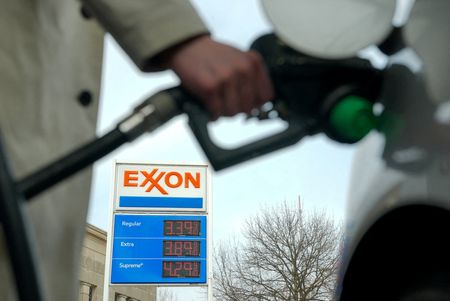

Energy corporation Exxon Mobil announced Wednesday that escalating oil and natural gas prices stemming from the U.S.-Israeli conflict with Iran may generate upstream earnings increases reaching $2.9 billion during the first quarter, despite operational disruptions affecting some Middle Eastern production facilities.
The company’s downstream operations face different challenges, with projected losses of approximately $5.3 billion primarily due to timing factors, according to a regulatory filing. Exxon indicated these earnings will recover in subsequent quarters once oil and gas deliveries reach their destinations.
The military action that commenced February 28 caused oil prices to surge as high as 65%, forcing several Middle Eastern energy facilities to halt operations after the Strait of Hormuz – which handles one-fifth of worldwide energy transport – was essentially blocked. Data from LSEG shows Brent crude averaged $78.38 per barrel in the first quarter, representing a 24% increase from the prior three-month period.
According to the filing, Exxon’s first-quarter oil and gas output will drop 6% because of the conflict compared to fourth-quarter production of 5 million barrels of oil equivalent daily. The company noted that facilities in Qatar and the UAE represented 20% of Exxon’s worldwide oil production in 2025.
Complete first-quarter financial results are scheduled for release May 1. Market analysts closely monitor the company’s preliminary earnings data, which outlines market conditions affecting profits, as indicators for broader oil industry performance when results emerge next month.
Timing factors may reduce downstream first-quarter profits by $3.3 billion to $4.1 billion versus the fourth quarter. Chief Financial Officer Neil Hansen described this “unusually large, negative timing impact” as temporary, resulting from accounting regulations within the trading operations.
“These impacts will unwind over time and result in net positive profit once the underlying transactions are complete. These are sound trades and the profitability that will result from them will be material,” Hansen stated.
Similar to other petroleum companies, Exxon uses financial derivatives to hedge crude oil, natural gas, and refined product sales, reducing price volatility risks during shipping periods that can span weeks between the United States and Asia. The physical shipment value doesn’t appear in earnings until transactions conclude, the company explained.
Exxon will record impairment charges between $600 million and $800 million due to supply disruptions that prevented physical cargo deliveries associated with certain hedging positions.