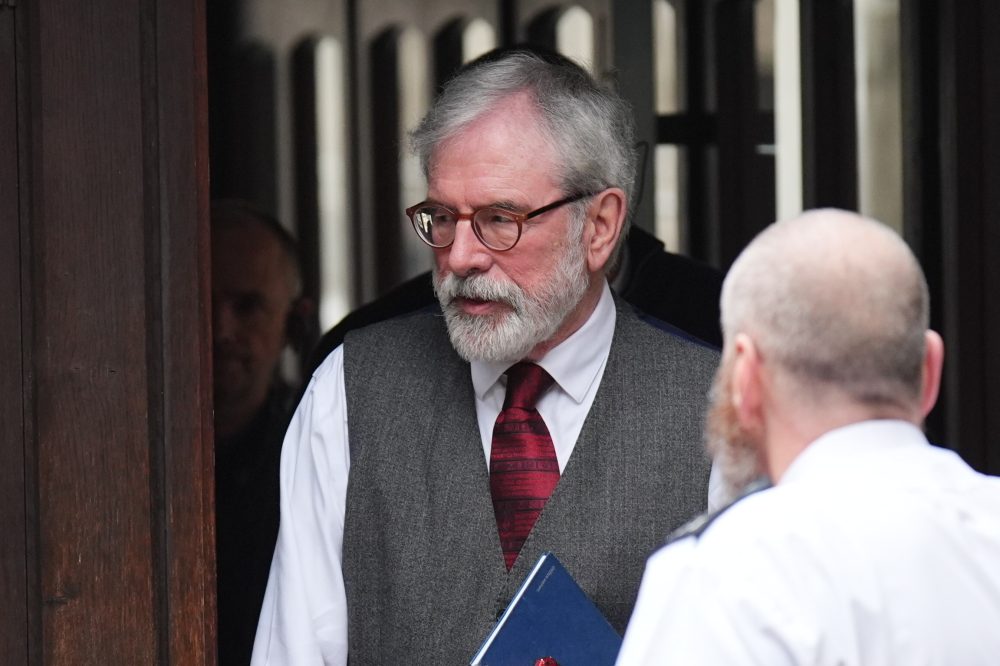

A London courtroom became the stage Monday for allegations against Gerry Adams, the former head of Sinn Féin, as three bombing victims claim he held leadership positions within the Irish Republican Army during deadly attacks in England.
The civil lawsuit filed in London’s High Court alleges Adams bore direct responsibility for Provisional IRA decisions to carry out explosive attacks in England during 1973 and 1996.
Attorney Anne Studd, representing the three injured men, told the court that Adams made false distinctions between his roles. “The defendant carefully draws a distinction between being a member of ‘the Army’ and being a member of Sinn Féin,” Studd stated. “That was a distinction without a difference.”
While these accusations against Adams have circulated for years, this marks the first instance where a court will determine their validity.
Adams served as a pivotal figure during Northern Ireland’s violent era, heading the IRA-associated Sinn Féin party from 1983 through 2018 and playing a crucial role in negotiating the 1998 Good Friday peace agreement. Despite consistent denials of IRA membership, several former associates have claimed he held leadership roles within the organization.
“There is no doubt that the defendant contributed to the peace in Northern Ireland, but the claimants say that on the evidence, he also contributed to the war,” Studd argued.
The three plaintiffs seek acknowledgment rather than financial compensation, pursuing damages of just one pound ($1.33) from Adams.
Their lawsuit claims Adams served on the IRA’s governing Army Council and shares equal responsibility with those who physically planted explosives during “the Troubles” – three decades of bloodshed involving Irish republican militants, British loyalist groups, and UK military forces. This period claimed approximately 3,600 lives, primarily in Northern Ireland, though IRA operations extended to England.
Police officer John Clark sustained shrapnel wounds to his head and hand during the 1973 Old Bailey courthouse attack in London. Jonathan Ganesh experienced psychological trauma from the 1996 London Docklands explosion. Barry Laycock suffered 50% disability, emotional distress, and financial hardship following the 1996 Arndale shopping center bombing in Manchester.
Defense attorney Edward Craven stated that Adams, who plans to testify during the jury-free trial scheduled to end next week, “emphatically, unequivocally and categorically denies that he was ever a member of the IRA.”
Craven emphasized that the 77-year-old was never formally charged with these bombings or even detained on suspicion of involvement.
Adams faced IRA membership charges in 1978, though prosecutors later abandoned the case due to insufficient evidence.
Last year, Adams secured a £100,000 ($116,000) libel judgment against the BBC regarding a television documentary’s assertion that he approved killing an informant within Irish republican circles.
Craven described the plaintiffs’ burden of proof as insurmountable, saying they “had a mountain to climb to prove their case and they had not even arrived at the foothills.”
The defense acknowledged that Adams supported IRA objectives and attempted to rationalize their actions, though he didn’t endorse every operation.
“That makes him, in the eyes of some people, a deeply controversial figure,” Craven explained. “It does not mean he was factually responsible for the bombings.”