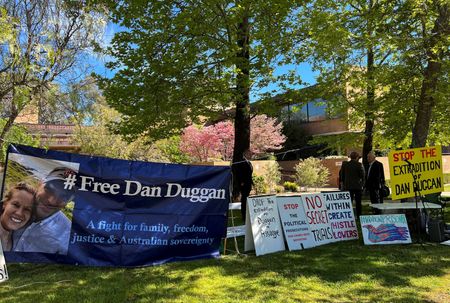

An Australian federal court has rejected an appeal from a former U.S. Marine pilot fighting extradition to America, where he faces serious weapons charges related to training Chinese military pilots.
Daniel Duggan, who became an Australian citizen, was taken into custody in New South Wales during October 2022 at the request of U.S. authorities. His arrest came shortly after he returned from China, where he had been residing since 2014.
Australia’s former attorney-general Mark Dreyfus gave the green light for Duggan’s extradition to the United States in December 2024.
Duggan’s legal team contested the extradition ruling, claiming the attorney-general committed procedural mistakes and failed to correctly interpret Australia’s Extradition Act alongside the bilateral extradition agreement with America.
However, Federal Court Judge James Stellios rejected the challenge on Thursday, determining that no legal mistakes had occurred in the original decision.
“I am not persuaded that the impugned decisions were infected by jurisdictional error. Therefore, the application must be dismissed,” the judge stated.
Current Attorney-General Michelle Rowland’s office acknowledged the court’s decision through a spokesperson.
“Mr Duggan will remain in extradition custody in Australia until his surrender to the United States of America,” the statement read.
Duggan, a father of six children living in Australia, has remained behind bars since his initial arrest.
His spouse, Saffrine, expressed the family’s disappointment with the outcome to Australia’s public broadcaster ABC, while indicating they would explore their remaining legal options. “Make no mistake: we will not give up,” she declared. The family has 28 days to file an appeal.
American authorities want Duggan extradited to face four criminal charges stemming from his alleged involvement in training Chinese pilots in South Africa from 2009 through 2012.
The charges include conspiracy to break U.S. arms export regulations and defraud the government, which could result in five years imprisonment. He also faces two separate arms export control violations, each carrying potential 20-year sentences, plus one money laundering conspiracy charge that could add another 20 years behind bars.
Duggan’s defense attorneys contended that his alleged actions weren’t considered crimes in Australia when they occurred or when America requested his extradition, failing to meet the “dual criminality” standard required under the Australia-U.S. extradition treaty.
The court ruled that the treaty doesn’t modify Australia’s Extradition Act to mandate “dual criminality,” meaning Australia wasn’t required to deny the American extradition request on those grounds.