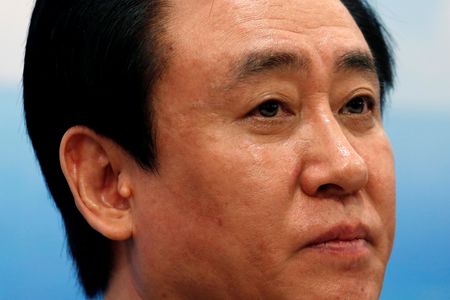

The dramatic downfall of a Chinese real estate mogul reached its conclusion as Hui Ka Yan, founder of the now-collapsed China Evergrande Group, entered guilty pleas to fraud and bribery charges.
Less than three years ago, in July 2021, Hui appeared confident and relaxed at Chinese Communist Party centenary celebrations in Tiananmen Square. Dressed in a navy suit with an open collar, the 67-year-old businessman stood among China’s elite, discussing his company’s debt reduction plans just weeks after addressing over 1,000 suppliers about the same goals.
That appearance, viewed by many as official endorsement of the billionaire, now seems like the final act before an unprecedented corporate collapse.
Today, Evergrande faces liquidation with debts exceeding $300 billion – roughly matching Finland’s entire economic output. Hui’s guilty plea, entered after three years in custody, officially closes the chapter on a business empire whose failure sent shockwaves through China’s property market and international investment circles.
The son of a rural village in Henan province, raised by his grandmother, Hui began his career as a steel technician before building a real estate fortune focused on affordable housing. He established Evergrande in 1996 in Guangzhou, growing the company through aggressive expansion funded by extensive borrowing for land acquisitions.
Evergrande’s strategy centered on selling homes with thin profit margins but rapid turnover, eventually reaching annual sales of 700 billion yuan ($103 billion) by 2020.
At his peak in 2017, Forbes ranked Hui as Asia’s wealthiest individual with assets worth $45.3 billion. By 2023, that figure had plummeted to an estimated $3 billion.
Former employees described Hui as intensely private and demanding, expecting staff to match his workaholic approach. He consistently set bold objectives and, when challenged about his company’s heavy debt load, maintained that Evergrande’s rapid sales and asset values would cover all obligations.
Hui strategically aligned his business ventures with Chinese leadership priorities, investing in electric vehicles and soccer – both interests of President Xi Jinping.
Beyond mainland China, Hui cultivated relationships with Hong Kong’s business elite, joining an exclusive “poker club” where wealthy investors often collaborated on deals.
“He was very composed when he was first brought to the club; he knowingly lost a lot of money in the games and gained the fondness of Cheng,” recalled one source familiar with the group, referencing Cheng Yu Tung, the deceased founder of New World Development.
This relationship proved valuable when Cheng invested $150 million in Evergrande before its 2009 Hong Kong stock listing, providing crucial support during the financial crisis as the company pursued aggressive growth.
However, Hui’s debt-heavy business model increasingly concerned regulators, who repeatedly urged Evergrande to address its financial structure to prevent broader economic damage.
At the 2018 China Charity Awards, where he won recognition for the eighth straight year, Hui reflected on his company’s contributions and his personal journey.
“Without the country’s policy to reform higher education, I could not have left the village. Without the country giving me a scholarship of 14 yuan every month, I could not have completed university,” Hui stated.
“Without the country’s good policy to reform and open up, Evergrande would not have become what it has today. Therefore, everything that Evergrande and I have, they are all given by the Party, by the country, and by society.”
He noted that Evergrande had contributed 185 billion yuan in taxes over 22 years and donated more than 10 billion yuan to charitable causes.
Court-appointed liquidators for Evergrande declined to provide statements, while attempts to reach Hui for comment were unsuccessful.