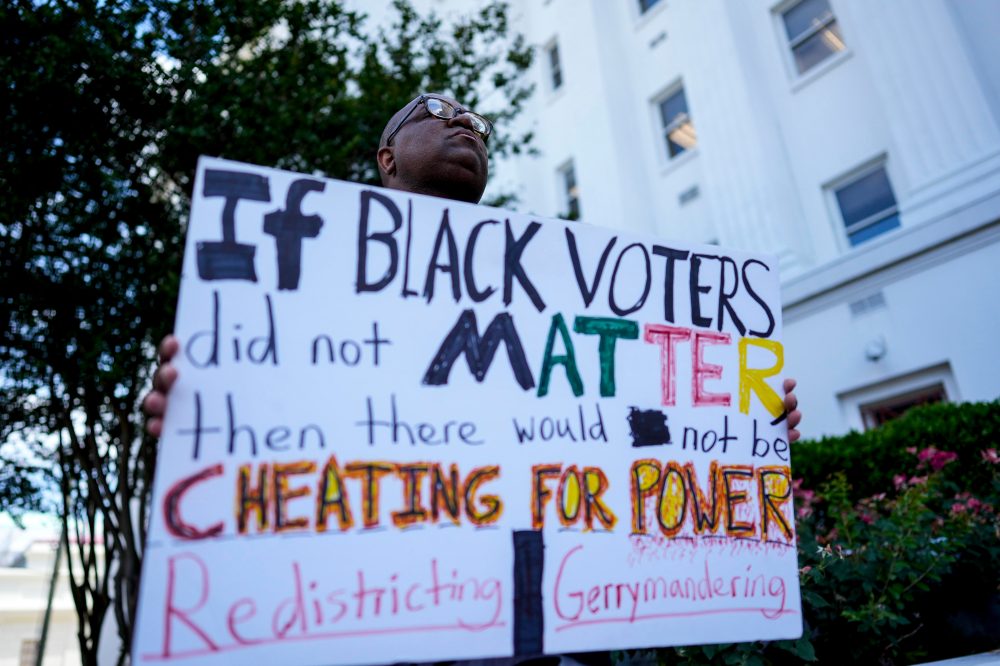

Thousands gathered Saturday in Montgomery, Alabama — the historic center of the Civil Rights Movement — to launch a new push for voting rights as conservative states eliminate congressional districts that ensured Black political representation.
“The bottom line is we are seeing a full-fledged, coordinated attack on Black political power that can actually reshape the entire political landscape, not just on the South but throughout the nation,” said LaTosha Brown, co-founder of Black Voters Matter.
The demonstration started in Selma, site of the brutal 1965 confrontation between police and civil rights marchers that sparked passage of the Voting Rights Act. Participants then traveled to the state Capitol, where the Rev. Martin Luther King Jr. delivered his “How Long, Not Long” address that same year.
“We’re picking up where it was left because we still have unfinished business,” Brown said. “There will not be a new Jim Crow.”
A recent Supreme Court decision involving Louisiana further eroded voting rights protections that had already been damaged by a 2013 ruling and subsequent court decisions. These changes opened the door for tougher voter ID requirements, registration barriers, and restrictions on early voting and polling locations — including in states previously required to get federal approval before changing election laws due to their history of discriminating against Black voters.
Civil rights veterans express shock at how quickly these protections are disappearing, pointing out that rights earned through decades of struggle have been undermined in just over ten years.
Kirk Carrington, 75, was a teenager in 1965 when police attacked demonstrators in Selma during what became known as “Bloody Sunday.” A white man on horseback carrying a club pursued Carrington through the streets.
“It’s really just appalling to me and all the young people that marched during the ’60s, fought hard to get voting rights, equal rights and civil rights,” Carrington said. “It’s sad that it’s continuing after 60-plus-odd years that we are still fighting for the same thing we fought for back then.”
Montgomery sits within one of the congressional districts now being modified following the Supreme Court decision.
A federal judge in 2023 redesigned Alabama’s 2nd Congressional District after determining the state deliberately weakened Black voters’ influence, though they comprise roughly 27% of the population. The judge ruled there should be a district where Black residents form a majority or near-majority and can elect their preferred candidate.
However, the Supreme Court allowed a different map that could help the GOP regain the seat. While legal challenges continue, the state has scheduled special primaries for Aug. 11 using the new boundaries.
Democratic Rep. Shomari Figures, who won the district in 2024, said the fight isn’t about his position but about people’s right to representation.
“When Republicans are literally turning back the clock on what representation, what the faces of representation, look like, what the opportunities, legitimate opportunities for representation look like across this country, then I think it starts to resonate with people in a little bit of a different way,” Figures said.
Alabama House Speaker Nathaniel Ledbetter, a Republican, said the Louisiana decision created a chance to reconsider a map imposed by federal courts.
“People tend to forget what happened. When this thing went to court, the Republican Party had that seat, congressional seat two,” Ledbetter said last week. “There’s been a push through the courts to try to overtake some of these red state seats, and that’s certainly what happened in that one.”
Evan Milligan, the primary plaintiff in the Alabama redistricting lawsuit, said while there’s sadness over the collapse of voting rights protections, people must renew their commitment to the struggle.
“We have to accept that this is the new reality, whether we like it or not,” Milligan said. “We don’t have to accept that this will be the reality for the next 10 years or two years or forever.”