
European Union legislators took a significant step Thursday toward implementing their portion of a trade agreement with the United States, despite ongoing concerns about tariff policies and import duties.
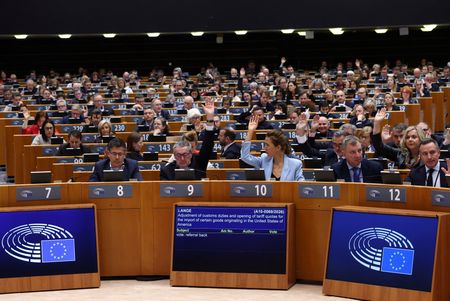
The European Parliament approved the trade legislation by a margin of 417 to 154, with 71 members abstaining. However, lawmakers incorporated additional protective measures, citing worries that Washington might not uphold the agreement negotiated in Turnberry, Scotland last July.
These protective provisions include a possible suspension mechanism and other safeguards. European legislators are demanding that the United States eliminate the 50% tariffs that were imposed one month following the Turnberry agreement on steel and aluminum components in products like wind turbines and motorcycles.
European Trade Commissioner Maros Sefcovic described the vote as a “crucial step” that provides certainty for businesses across the EU. The U.S. Mission to the European Union expressed its support for the parliamentary decision.
The European Parliament has been considering proposals to eliminate EU import taxes on American industrial products and expand market access for U.S. agricultural goods, which represents a central component of the agreement. The legislation also continues duty-free treatment for American lobsters, a provision originally negotiated with Trump in 2020.
Thursday’s parliamentary vote does not conclude the legislative process. Negotiations between parliament representatives and EU member governments will begin April 13 to finalize the text, with a final approval vote by EU lawmakers not anticipated until June. EU governments had already endorsed the legislation in November with fewer protective measures.
The United States serves as the European Union’s primary trading partner, with EU exports to America reaching a record 555 billion euros ($641 billion) in 2025.
During pre-vote discussions, numerous parliamentarians criticized the trade agreement as unbalanced, noting that the EU must reduce most import duties while the U.S. maintains a general 15% rate.
Bernd Lange, who chairs the parliament’s trade committee, questioned whether this constitutes a genuine agreement. Belgian Social Democrat Kathleen Van Brempt characterized it as an unfavorable deal.
“It does not bring stability. It does not protect us from tariffs, threats and coercion,” she said.
The EU assembly had originally planned to vote on this legislation at the beginning of the year but suspended proceedings after Trump threatened new tariffs on European allies that refused to support his proposed Greenland acquisition and subsequently implemented an import surcharge.
The additional safeguards include a sunrise provision making EU import duty reductions dependent on Washington fulfilling its obligations, a sunset clause that expires the tariff concessions on March 31, 2028, and a suspension mechanism if Washington violates the agreement terms or if there’s a harmful increase in U.S. imports.