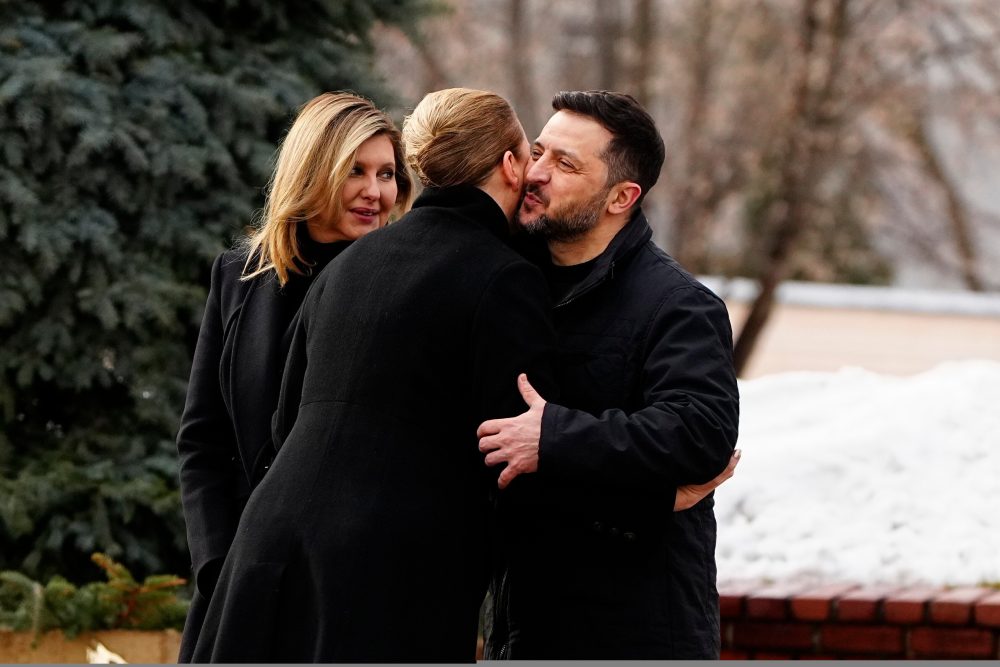

KYIV, Ukraine — Over a dozen high-ranking European leaders descended on Ukraine’s capital Tuesday, demonstrating continental solidarity as the nation observed four years since Russia launched its comprehensive military assault — a somber milestone in a conflict that has claimed countless lives and heightened European concerns about Moscow’s broader territorial aspirations.
Ukrainian President Volodymyr Zelenskyy declared that his nation has successfully resisted Russia’s larger and more advanced military forces, which managed to capture merely 0.79% of Ukrainian territory over the previous year of combat, based on data from the Institute for the Study of War, a Washington research organization.
“Looking back at the beginning of the invasion and reflecting on today, we have every right to say: we have defended our independence, we have not lost our statehood,” Zelenskyy posted on social media, asserting that Russian President Vladimir Putin has “not achieved his goals.”
“He has not broken Ukrainians; he has not won this war,” Zelenskyy also said.
Nevertheless, as this grinding conflict of endurance moves into its fifth year, diplomatic efforts led by the United States to resolve Europe’s largest military confrontation since World War II seem no nearer to identifying compromises that could enable a peace agreement.
Peace talks remain deadlocked over the future of the Donbas region — eastern Ukraine’s manufacturing center that Russian forces largely control but haven’t completely conquered — and the framework for post-conflict security guarantees that Kyiv insists upon to prevent future Russian aggression.
Military casualties on both sides — including dead, wounded, and missing personnel — could total 2 million by spring, with Russia experiencing the highest military fatalities of any major nation in any war since World War II, according to estimates released last month by the Center for Strategic and International Studies.
European leaders view their own national security as intertwined with Ukraine’s fate given concerns about Putin’s expanded objectives and have insisted on participation in the current U.S.-mediated negotiations.
German Chancellor Friedrich Merz wrote on X that “for four years, every day and every night has been a nightmare for the Ukrainians — and not just for them, but for us all. Because war is back in Europe.”
“We will only end it by being strong together, because the fate of Ukraine is our fate,” he added.
The conflict has involved nations well beyond Ukraine’s borders, creating international implications, and threatened to exacerbate supply shortages, food insecurity, and political unrest in developing nations worldwide.
Although NATO member states have provided assistance to Ukraine, Russia has received support from North Korea through troops and artillery ammunition; Iran through drone capabilities; and China, which according to U.S. officials and experts has supplied manufacturing equipment and computer components.
Tuesday’s European delegation to Kyiv included European Council President Antonio Costa, European Commission President Ursula von der Leyen, and Finnish President Alexander Stubb, alongside seven prime ministers and three foreign ministers.
Given Ukraine’s inability to continue fighting Russia without international assistance, NATO nations are now supplying military support, acquiring American weaponry after the Trump administration changed previous Washington policy that had ceased arms deliveries to Kyiv.
The European Union has additionally provided financial assistance, though it has occasionally faced resistance from member nations Hungary and Slovakia.
British Armed Forces Minister Al Carns characterized Russia’s war against Ukraine as “the most defining conflict” in recent decades.
“I don’t think anyone of us would be able to guess (when the war started) the scale and size of what has taken place,” he said.
Reconstruction expenses for war-damaged Ukraine would total nearly $588 billion over the coming decade, according to joint estimates from the World Bank, European Commission, United Nations, and Ukrainian government.
This figure represents almost triple Ukraine’s estimated nominal GDP for the previous year, according to their Monday report.