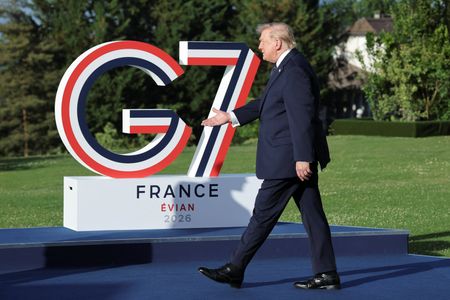

European leaders are preparing to challenge President Donald Trump at this week’s G7 summit in France, warning that a shallow interim agreement with Iran could allow Tehran to continue developing its nuclear and ballistic missile capabilities — while also calling on Trump to take a fresh look at his strategy for ending the war in Ukraine.
The summit, running from June 15 through 17 in Evian-les-Bains along the shores of Lake Geneva, has brought together the heads of government from France, Britain, Canada, Germany, Italy, Japan, and the United States, along with the European Union.
Trump touched down in France on Monday evening riding a wave of momentum after Washington and Tehran reached a preliminary agreement aimed at resolving the broader conflict, with a formal signing ceremony set for Friday.
“The Iran deal will bring a lot of success,” Trump remarked shortly after arriving in Evian-les-Bains.
PUSHING FOR A STRONGER NUCLEAR AGREEMENT
French President Emmanuel Macron stressed the need for what he called a “solid, serious agreement that is finalised.” He said a Tuesday lunchtime session would be devoted to the safe reopening of the Strait of Hormuz, including the possible launch of a Franco-British maritime mission and identifying energy supply routes that could bypass the waterway altogether. Trump, for his part, predicted the strait would be “completely open” by Friday.
Leaders from the United Arab Emirates, Qatar, and Egypt are also joining Tuesday’s discussions. Diplomats say those leaders are not expected to dig into the technical details of Iran’s nuclear program, but may lay out their broader expectations for the outcome.
The preliminary agreement is designed to open a 60-day window for complex follow-on negotiations covering issues such as what happens to Iran’s highly enriched uranium stockpile and the conditions under which sanctions could be lifted.
Still, European allies are worried that an inexperienced U.S. negotiating team might fall short of locking in a strong nuclear deal or fail to address Iran’s ballistic missile program in the next phase — potentially leading to a prolonged standoff.
France, Britain, and Germany — which first engaged Iran on nuclear issues back in 2003 and later partnered with then-President Barack Obama to craft the 2015 nuclear accord — are seeking a seat at the table for the upcoming negotiations after being largely pushed to the sidelines in recent months.
Trump dismissed the earlier agreement before heading into a one-on-one meeting with Macron, saying of his deal: “It’s not like the Obama document, that was a terrible document.”
EUROPE WANTS A RESET ON UKRAINE
European diplomats are also viewing the summit as a chance to persuade Trump that previous U.S. proposals for ending the fighting in Ukraine have tilted too far in Russia’s favor.
European nations want to signal their readiness to engage in peace talks with President Vladimir Putin, while simultaneously tightening sanctions on Russia and stepping up military aid to Ukraine — making clear that it is Moscow, not Kyiv, that is standing in the way of progress.
Trump said he believed Putin and Ukrainian President Volodymyr Zelenskiy were both “open to do something about the war.” Zelenskiy is scheduled to take part in the summit’s opening session, which is focused on “building peace in Ukraine,” and may also hold a separate conversation with Trump.
With negotiations stalled, Zelenskiy is pushing for a renewed push toward peace and a larger role for European nations in the process. He revealed Monday that he had offered to meet Putin at the G7 summit for direct talks to end the four-year conflict, but said Putin was not ready to engage.
European Commission President Ursula von der Leyen offered a pointed assessment of where things stand: “Ukraine is holding the front line and even partially regaining territory. Ukraine has developed the capability to strike strategic targets deep inside Russia. And Ukraine has become a world-leading producer of cutting-edge military equipment.”
She added: “On the other hand, Russia is feeling the strain and pressure of sanctions… Putin’s war economy has never been as weak.”
Zelenskiy has expressed concern that the conflict involving Iran has pulled U.S. attention away from Ukraine. Meanwhile, the situation on the battlefield has been shifting, with Ukrainian drones reaching deeper into Russian territory to disrupt supply lines and damage energy infrastructure.
A Kremlin foreign policy adviser said Putin believes that increased Ukrainian strikes on Russian targets will not change the overall military picture on the ground.