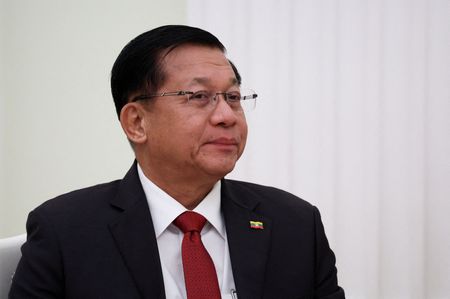

Myanmar President Min Aung Hlaing is receiving a significant diplomatic boost through a state visit to China, where he is expected to meet with Chinese President Xi Jinping. The five-day trip represents the highest level of diplomatic engagement and comes as the former military commander works to strengthen his authority over the conflict-ridden country following an election at the start of the year that drew widespread international condemnation.
The China visit follows a recent official trip to India, where Min Aung Hlaing met with Prime Minister Narendra Modi — though analysts noted that visit did not carry the full prestige of a formal state visit.
“An official state visit hosted by Xi Jinping is a visible signal that China is prepared to deal with Myanmar’s new administration as a full partner,” said Richard Horsey, the senior Myanmar adviser at Crisis Group. “India gave him a warm embrace on his recent visit, but not the full honours of an official state visit.”
While the diplomatic optics favor Min Aung Hlaing, analysts caution that Beijing’s priorities are firmly rooted in self-interest. China is Myanmar’s largest trading partner and top investor, with major Belt and Road Initiative projects in the country, including a cross-border oil and gas pipeline and a deep-sea port. Beijing also plays a key role as a military supplier and diplomatic ally for Myanmar’s armed forces, and has at times helped negotiate ceasefires along border regions controlled by ethnic armies with strong ties to China.
“China’s interests are not on federalism, but rare earths, infrastructure, mining, and securing the economic corridor to the Indian Ocean,” said David Mathieson, a Thailand-based independent analyst who closely follows Myanmar. “China also perceives the West in retreat from Myanmar and Beijing will assert a new suzerainty over the country.”
Myanmar has been engulfed in a brutal civil war since February 2021, when Min Aung Hlaing overthrew the elected government led by Aung San Suu Kyi. What began as protests against the military takeover evolved into a nationwide armed conflict, with the military fighting both newly formed pro-democracy groups and long-established ethnic armed organizations. The war has devastated the already impoverished Southeast Asian nation, claiming more than 93,000 lives and forcing more than 3.7 million people from their homes.
Despite the ongoing bloodshed, the military conducted a general election last December and January that blocked major opposition groups from participating. An army-backed party swept the vote, clearing the path for Min Aung Hlaing to assume the presidency.
The delegation traveling with Min Aung Hlaing to China includes the chief ministers of Kachin and Shan states — both of which share a border with China — along with Myanmar’s industry minister, according to state media reports. Kachin State, where fighting continues between the military and a major armed group, sits atop one of the world’s most significant heavy rare earth mining regions. Shan State maintains several key trade routes with China.
The presence of those ministers points to likely discussions around border commerce and the long-stalled Myitsone Dam, a $3.6 billion Chinese-backed project in Kachin State that was suspended in 2011, according to Aung Kyaw Soe, an independent analyst based in Thailand.
“In 2025, the military’s second-in-command, General Soe Win, personally began bringing up the subject of restarting Myitsone, so I think they will discuss restarting it during Min Aung Hlaing’s current trip to China,” Aung Kyaw Soe said.
Adding a layer of complexity to the visit is the recent detention in China of Min Zin, a well-known American scholar specializing in Myanmar, on suspicion of espionage. Crisis Group’s Horsey noted that the timing draws additional attention to the case. “Min Aung Hlaing’s visit will put a greater focus on Min Zin’s arrest, because he is one of the most prominent Myanmar scholars working to improve understanding between the two countries,” Horsey said.