
European Union foreign ministers on Monday firmly dismissed Russian President Vladimir Putin’s proposal that former German Chancellor Gerhard Schroeder could serve as Europe’s representative in potential future security negotiations with Moscow.
Putin had indicated over the weekend that he believed the conflict in Ukraine was nearing its conclusion and expressed willingness to discuss new European security frameworks, with Schroeder as his preferred negotiating partner.
However, EU foreign ministers gathering in Brussels for their scheduled meeting expressed serious doubts about Russia’s genuine commitment to ending the conflict and engaging in authentic peace discussions for Europe.
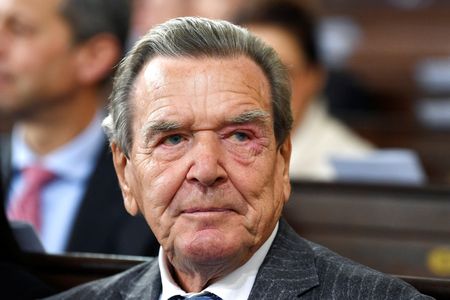
The ministers completely rejected any involvement from Schroeder, who has maintained employment with Russian state enterprises and developed a personal friendship with Putin over the years.
EU foreign policy chief Kaja Kallas explained the obvious conflict of interest to reporters: “It’s clear why Putin wants him to be the person – so that actually … he would be sitting on both sides of the table. If we give the right to Russia to appoint a negotiator on our behalf … that would not be very wise.”
Germany’s Europe minister, Gunther Krichbaum, stated that Schroeder, who led Germany from 1998 to 2005, lacks the qualifications to serve as an “honest broker.”
“He is, and certainly has been, heavily influenced by Mr Putin. Close friendships may be legitimate anywhere in the world, but they do not help one to be perceived as an impartial mediator,” Krichbaum explained.
Since Russia’s invasion of Ukraine in 2022, the European Union has maintained a strategy of diplomatically isolating Moscow through comprehensive sanctions and minimal high-level political engagement.
Despite this approach, some European officials have begun advocating for direct EU engagement with Russia as U.S.-led peace efforts show limited advancement, particularly as Washington shifts focus to the conflict involving Iran.
European Council President Antonio Costa revealed last week that he has been consulting with fellow EU leaders “to organise ourselves and to identify what we need” for eventual discussions with Russia when “the right moment” arrives.
Ukrainian Foreign Minister Andrii Sybiha suggested the EU could participate in negotiations that would be “complementary” to U.S.-led talks, though he provided no additional specifics.
“We could talk about (a) new role of Europe,” Sybiha told Brussels reporters. “We have mainstream peace talks under the leadership of the U.S.A. and we need this track … but Europe could play also its role.”
Kallas and several other ministers emphasized that the EU should first intensify pressure on Russia and establish clear negotiating objectives before considering any discussions or selecting representatives.
“It’s not about choosing someone,” said Lithuanian Foreign Minister Kestutis Budrys. “We should get to the basics and the basics is to get our tools ready to pressure Russia.”
Austrian Foreign Minister Beate Meinl-Reisinger supported greater EU involvement in Russian negotiations and appointing a negotiating team.
“But we will decide that – Russia won’t decide it,” she declared.