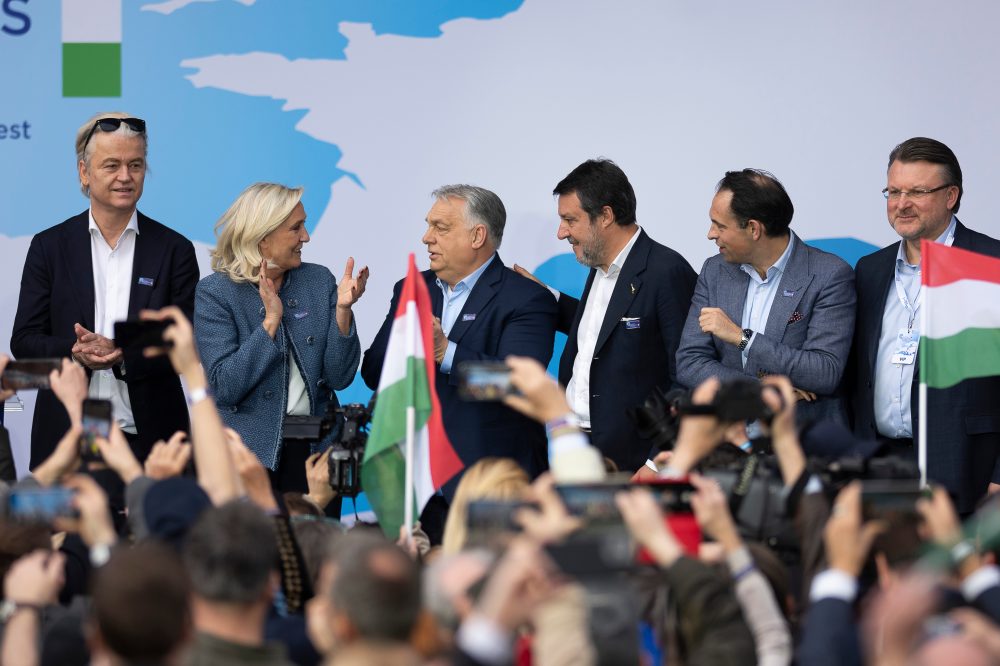

BUDAPEST, Hungary — More than a dozen leaders from European far-right political parties converged on Hungary’s capital Monday to demonstrate solidarity with Prime Minister Viktor Orbán, whose upcoming April election could determine the future direction of the nationalist movement across Europe and the United States.
Since regaining control of Hungary in 2010, Orbán has established himself as a central figure in the international far-right movement, even before former U.S. President Donald Trump launched his 2016 campaign.
The Hungarian prime minister’s political achievements — including four consecutive electoral wins, comprehensive control over government institutions, media outlets and universities, plus his focus on traditional family principles — have made him a model for conservative success in both America and Europe.
However, with just three weeks remaining before Hungarian voters head to the ballot box, polling data indicates Orbán trails a center-right opponent — suggesting his decade-and-a-half in power and his influence within conservative circles may be ending.
Princeton University professor Kim Lane Scheppele, who specializes in sociology and international affairs, noted that despite Orbán’s significant European influence and popularity among Trump’s MAGA supporters, the upcoming vote carries enormous consequences.
“Hungary is this kind of proof of concept that the MAGA kind of politics can work,” Scheppele said. “If Orbán loses, then it loses some of that luster.”
Monday’s Budapest meeting brought together the Patriots for Europe organization, established in 2024 by Orbán and his nationalist allies.
This coalition represents the European Parliament’s third-largest faction, with member parties from 13 EU nations united by their opposition to immigration, preference for national control over European unity, and commitment to traditional social principles.
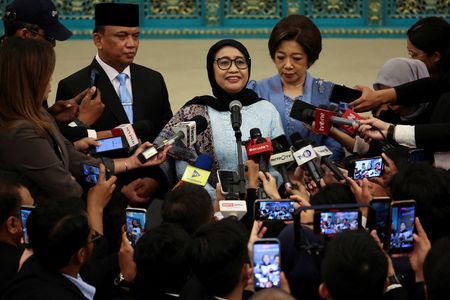
The gathering featured prominent figures including France’s Marine Le Pen, Italy’s Matteo Salvini, and the Netherlands’ Geert Wilders. Each of the 13 speakers addressed the audience, praising Orbán and encouraging Hungarian voters to support him and his Fidesz party in the April 12 contest.
Le Pen, currently appealing a March 2025 conviction for misappropriating European Parliament resources, commended Orbán’s stance on “immigration, identity and sovereignty.” She described Hungary as “an emblem of the resistance of a proud and sovereign people to oppression.”
“On April 12, you will send a new message of strength and determination to tired old technocrats in Brussels,” she told the crowd.
The Patriots organization has cultivated relationships with Trump and his MAGA supporters, adopting the motto “Make Europe Great Again.” Orbán has consistently predicted a nationalist takeover across Europe, positioning the Patriots as the mechanism to accomplish this goal.
During the Budapest assembly, Orbán declared the Patriots “are talking openly about wanting to take control of the European Union. We want to occupy and transform the center of Brussels.”
Professor Scheppele explained that Orbán’s importance to European far-right success stems from his ability to leverage Hungarian state power and financial resources to advance their objectives.
“Hungary has been really important because it’s been governed for 16 years by somebody trying to build this movement, and that means that it’s kind of a safe haven,” she said.
Orbán’s reach extends well beyond European boundaries. He and Trump maintain a mutual admiration, regularly exchanging public praise and campaign support.
Demonstrating Orbán’s ongoing appeal among American conservatives, Budapest hosted the fifth Hungarian Conservative Political Action Conference (CPAC) on Saturday. There, Orbán proclaimed the West was experiencing “the greatest political realignment of the past hundred years.”
“The epicenter of this realignment, its center of power, is the United States, and its forward base in Europe is Hungary,” he said.
Trump sent a video message to CPAC endorsing Orbán’s reelection bid and applauding his protection of “your borders, your culture, your heritage, your sovereignty, and your values.”
Scheppele observed remarkable similarities between Orbán’s Hungarian accomplishments and what Trump supporters envisioned for a second presidential term in America.
“A lot of the inspiration for the way that MAGA launched itself and developed a kind of political program to consolidate power very quickly was modeled on Orbán,” she said. “These are really interlocking networks and I think that the (Hungarian) election therefore looms very large in the MAGA political imagination.”
Orbán’s current political difficulties — driven by persistent economic stagnation, deteriorating public services, and mounting corruption accusations — mirror challenges facing Trump’s movement.
As Hungary’s election nears and Trump potentially faces losing one of his most vocal international supporters, the former president confronts declining approval ratings due to the Iran conflict and an immigration enforcement campaign whose public support has declined sharply.
Trump’s Republican Party anticipates substantial defeats in November’s midterm elections.