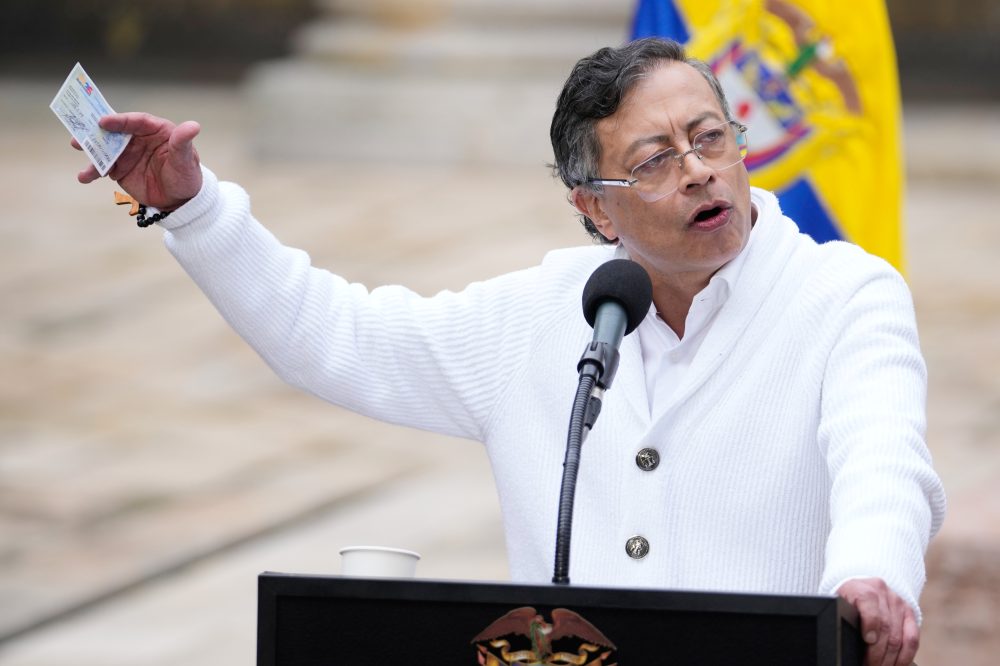

BOGOTA, Colombia (AP) — European Union election monitors have rejected Colombian President Gustavo Petro’s allegations of voting irregularities following Sunday’s heated presidential contest, describing the ballot counting process as conducted in a “transparent, orderly and fluid” manner.
Mission leader Esteban González Pons stated that none of the 12 presidential hopefuls approached his team with concerns about voting problems. A runoff election is set for June 21 between attorney Abelardo de la Espriella and Sen. Iván Cepeda, who received the highest vote totals.
Cepeda, who represents Petro’s Historical Pact party, declined Sunday to accept preliminary vote tallies showing him in second place, stating he would await the comprehensive count supervised by judicial officials and notaries before commenting. Before Cepeda’s remarks, Petro posted on X platform claiming 800,000 people were unlawfully added to voting lists. Over 23 million citizens voted Sunday, with de La Espriella capturing 43.7% and Cepeda earning 40.9%, according to official tallies.
By Monday, Cepeda moderated his position, noting that election watchers from his party had not discovered “irregularities of a sufficient dimension to speak of fraud.” He also predicted victory over de La Espriella in the runoff and proposed a debate.
Petro, who is constitutionally barred from seeking another term, reinforced his fraud allegations Tuesday through another X post, claiming without evidence that 885,000 voters registered past a March 31 cutoff date.
The president additionally alleged that certain polling locations recorded unusually high ballot numbers.
Colombia’s National Registrars Office, responsible for election administration, announced Monday evening that after reviewing 99.98% of polling stations, they found only a tiny 0.06% difference from Sunday’s preliminary count.
The EU monitoring team stated Tuesday they examined randomly chosen vote tallies from across Colombia and compared them with actual ballots, discovering no discrepancies.
“We can discard any manipulation of data in the quick count and in the final count,” González Pons declared.
Colombian election law requires judges, not the president, to verify and certify results, usually within two weeks.
Political watchers have cautioned that Petro’s unsupported fraud claims might deepen political divisions and encourage violence before the June 21 runoff.