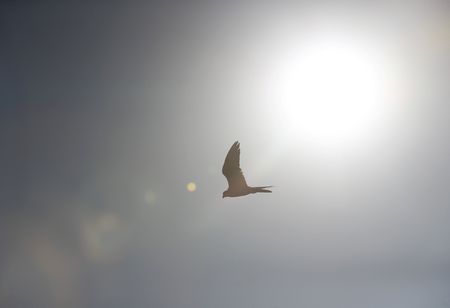

The sound of powerful wings echoed across the barren terrain as dozens of saker falcons launched into the sky above Kazakhstan’s Altyn-Emel National Park on April 3rd, marking a significant step in efforts to save an endangered species.
These 34 birds represent hope for reviving Kazakhstan’s dwindling saker falcon population, a species that has held deep cultural meaning for the region’s nomadic communities for generations, representing both nobility and freedom while serving as trusted hunting partners.
The conservation initiative is spearheaded by Saudi Arabia’s government-operated Saudi Falcons Club, working alongside a Kazakh research institute to combat the decline of these “Red List” endangered birds. Plans call for releasing between 35 and 45 falcons each year through 2027.
These migratory raptors, boasting wingspans ranging from 38 to 50 inches, inhabit territories stretching from central Europe through northeastern China. However, Kazakhstan has witnessed a devastating 90% drop in saker falcon numbers in recent years, primarily attributed to the destruction of their natural habitats, according to wildlife researchers.
Ahmed Fahd Al-Hababi, who serves as executive vice president of the Saudi Falcons Club, explained that Kazakhstan’s ecosystem provides optimal nesting conditions for these birds, making it a prime location for reintroduction efforts.
“We are returning the falcons to their natural habitat so they can breed and thrive in the wild,” he said.
Each released falcon has been equipped with GPS tracking devices and microchips, enabling researchers to monitor their movement patterns and study their behavior in the wild.