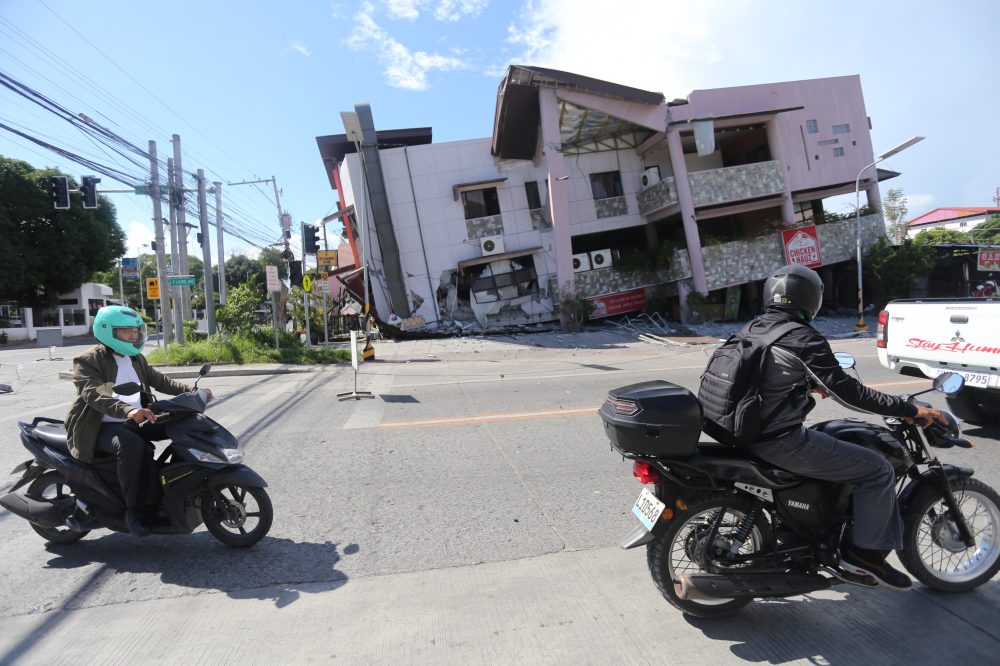

Officials in the Philippines announced Friday that extensive emergency preparedness training helped minimize casualties when a massive earthquake – among the most powerful in five decades – devastated the southern region, resulting in 55 fatalities and 31 people still unaccounted for.
The offshore earthquake measuring 7.8 on the Richter scale occurred Monday near Sarangani province, causing injuries to approximately 1,120 individuals and forcing more than 45,000 residents from their homes. About half of those displaced remain in temporary emergency housing after the tremor destroyed over 12,600 residential structures throughout agricultural communities and urban areas.
Authorities reported that numerous residents remain reluctant to return to their homes due to ongoing aftershocks and psychological trauma from the event.
In the aftermath of the seismic event, additional footage has emerged on social media platforms capturing the terrifying moments as people watched smaller structures crumble and witnessed morning flag ceremonies at schools descend into chaos when the earth began trembling on students’ first day back from summer vacation.
The recordings show pupils crying out in fear while remaining in their positions outside educational facilities, with some shielding their heads as educators urged them to stay calm.
A particularly striking video that has gained widespread attention on Facebook, accumulating millions of views, captured dozens of elementary students wailing and weeping as they remained seated on school grounds surrounded by trees, with the earth visibly moving them back and forth. When a nearby metal-roofed structure crashed down with a thunderous sound, many children attempted to flee but were instructed by their teachers to return to their designated spots.
The elementary school located in the coastal community of Malita in Davao Occidental province sustained no injuries during the earthquake.
“This incident serves as a reminder of the importance of earthquake preparedness and the value of regular disaster response drills,” the Mahayahay elementary school said in a statement.
According to Teresito Bacolcol, director of the Philippine Institute of Volcanology and Seismology, extensive disaster readiness training enabled residents to prepare for and respond to catastrophic events like Monday’s earthquake, ranking among the most severe to impact the island nation in fifty years.
Bacolcol noted the fortunate timing of the earthquake, which occurred at 7:37 a.m., just moments before employees and students would have been inside buildings for work and classes.
“It’s good that our efforts to educate people on what to do when earthquakes hit somehow paid off,” Bacolcol told The Associated Press.
However, he voiced concerns about certain building collapses, stating these structures should have survived the intense shaking if proper construction standards outlined in national building regulations had been implemented.
Ednar Dayanghirang, director of the Office of Civil Defense in the affected region housing approximately 5 million residents, explained that consistent emergency preparedness exercises helped minimize casualties through various means, including preventing fatal crowd rushes.
“We required all school principals to take one-day courses on incident management, then they appointed disaster-response teams among teachers to deal with earthquakes, tsunamis,” Dayanghirang said. “They listened and they learned.”
The Philippines ranks among the globe’s most disaster-vulnerable nations, frequently experiencing seismic activity and volcanic activity due to its position along the Pacific “Ring of Fire,” a curved zone of geological fault lines surrounding the ocean.