
CAIRO (AP) — Egyptian researchers have discovered a remarkable collection of ancient treasures, including burial furnishings from the Pharaonic era, remnants of a Roman religious structure, and a carved marble representation of Aphrodite, the Greek deity associated with love and beauty.
These findings, revealed on Sunday, represent part of Egypt’s strategy to revitalize its tourism sector and generate revenue for its struggling economy. Central to this initiative was the November opening of the much-anticipated Grand Egyptian Museum, a massive development situated close to the renowned Giza Pyramids and the Sphinx.
The basilica remnants and Aphrodite sculpture were discovered at an ancient burial ground in Beni Suef province, located 130 kilometres (80 miles) south of Cairo, according to the Tourism and Antiquities Ministry.
The Ehnasiya burial site, also recognized by its historical Roman designation Heracleópolis Magna, ranked among ancient Egypt’s most important urban centers.
Mohammed Abdel-Badei, who leads the antiquities department at the Supreme Council of Antiquities, explained that researchers discovered massive stone blocks that supported columns, with some weighing as much as 45 tons and used in the basilica’s construction. He noted that three blocks continue to stand in their original locations.
The Aphrodite sculpture, measuring approximately 24 centimeters by 25 centimeters (9½ inches by nearly 10 inches), displays intricate details of the deity’s facial features and flowing hair, demonstrating the traditional artistic styles of Greek and Roman eras, according to his description.
Researchers discovered carved writings connected to Senusret III, whose reign spanned from 1837 B.C. to 1819 B.C. during the historic 12th Dynasty. These inscriptions feature his royal and birth designations of the Pharaoh, alternatively called Sesostris III, who stands as one of Egypt’s Middle Kingdom’s most notable leaders.
Additional discoveries included pieces of wall sculptures and clay molds, thought to have been utilized for creating coins during Roman rule. These artifacts demonstrate that Ehnasiya served as a bustling economic and trade center while Egypt remained under Roman control from 30 B.C. to A.D. 395, Abdel-Badei explained.
In Cairo, researchers uncovered an almost intact collection of burial furnishings in the Matariya district, which previously belonged to the historic city of Heliopolis, the ministry reported.
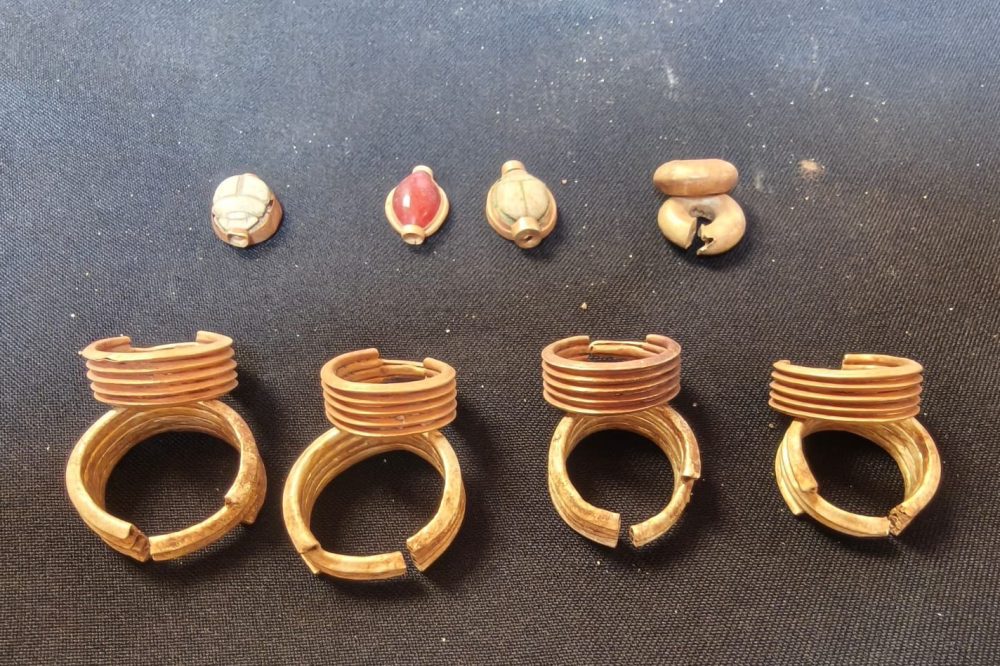
Abdel-Badei explained that excavators found a mud brick tomb containing golden remains within a coffin, thought to belong to a military official. They also discovered various beauty implements, including a bronze mirror and alabaster containers for eye makeup.
Researchers also found a set of yellow-toned metal earrings, featuring five pairs of different dimensions, suspected to be crafted from gold, he added.
The discoveries in Beni Suef and Cairo represent the most recent archaeological finds, which officials hope will strengthen the crucial tourism industry, partly sustained by visitors interested in ancient sites.
The tourism sector has faced challenges during periods of political unrest and conflict following the 2011 uprising. Recently, it has begun recovering from the coronavirus pandemic and economic impacts of the Russia-Ukraine conflict — both nations serve as significant sources of Egyptian tourists.
A historic total of approximately 19 million visitors traveled to Egypt last year, representing a 21% growth from 2024, based on government statistics. The initial four months of 2026 recorded 6.1 million tourists entering the country, compared to 5.7 million during the corresponding period in 2025, the prime minister’s office announced in May.