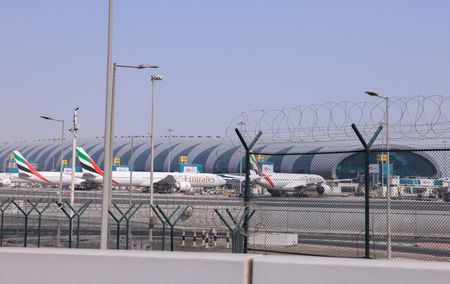

Recent escalations in Middle East tensions have exposed just how dependent worldwide aviation has become on a select few major airport hubs, with Dubai’s international airport – the globe’s busiest – at the center of widespread travel disruptions.
The Gulf region’s commercial powerhouse has built an impressive aviation empire over four decades, growing from Emirates’ humble beginnings with just two leased aircraft and a pair of flight routes to today’s massive operation connecting 110 countries through 454,000 annual flights.
“That we’ve got such a well-spread geographic business model and are well spread between visitors and those in transit suggests it’s very robust and will continue to survive any geopolitical tension that exists, wherever it may be,” Dubai Airports CEO Paul Griffiths told Reuters in a recent interview.
However, Saturday’s U.S. and Israeli military actions against Iran brought these regional conflicts directly to Dubai’s front door, including a direct assault on the airport facility itself.
Now Dubai confronts the enormous challenge of managing tens of thousands of stranded travelers while rebuilding its flight network and protecting incoming traffic that makes up half of its operations.
Industry experts generally believe the Gulf aviation hubs will bounce back from this setback, provided regional warfare doesn’t drag on indefinitely. However, the simultaneous closure of all three primary Gulf hubs – Dubai, Abu Dhabi and Doha – comes at a time when competitors from Turkey, Saudi Arabia and India are expanding their own operations.
“There’s no doubt at all this is temporary. They have seen major incidents before and recovered very quickly due to their importance as global hubs,” said UK-based travel consultant Paul Charles. “They will recover quickly, even if there is substantial uncertainty in the short term.”
Some analysts express more skepticism about the recovery timeline. While the aviation sector rebounded from pandemic losses due to demand exceeding available flights, this situation threatens passenger demand itself.
“Travellers are likely to consider more direct flights rather than stop over in Dubai or Doha. All this hub traffic is likely to take a hit,” said independent aviation adviser Bertrand Grabowski.
Despite these concerns, geography and economics continue working in the Gulf hubs’ favor.
“One third of the world’s population is within four hours’ flying time and two thirds within eight hours,” said Dubai Airports’ Griffiths.
“We’ve seen the incredible aggregation power that a hub delivers.”
Nevertheless, challenges to the Gulf’s aviation dominance are emerging. Turkish Airlines stands to gain significantly through its major hub positioned outside the conflict area, according to independent aviation analyst John Strickland.
Saudi Arabia is also expanding its aviation presence, with India following suit as Asian carriers capture more passengers.
Technical improvements in aircraft manufacturing, which previously benefited Gulf carriers, are now working against their hub model. Airbus recently started construction on a second ultra-long-range A350 aircraft to support Qantas plans for direct Sydney-to-London service.
Emirates launched operations during the height of the Iran-Iraq conflict in 1985. Its explosive expansion contributed to Gulf Air’s breakup – the airline that previously served Qatar, Bahrain, Abu Dhabi and Oman – as Qatar and Abu Dhabi established independent carriers, creating today’s three competing Gulf aviation hubs.
With Dubai’s reputation for stability now questioned following Iranian attacks and defensive missile debris, analysts say the biggest uncertainty surrounds future passenger traffic to Dubai itself.
The timing has also raised concerns about the already-postponed development of a massive new airport facility outside the city.
Dubai destination traffic “will doubtless recover, but there is likely to be some lasting damage”, Grabowski said.
For Emirates and its partner airline flydubai, recovery may require leveraging their market influence to restore normal operations.
“People have short memories and they might be incentivised by some bargain deals to bring people back, but I don’t think that would need to be there for long,” said Eddy Pieniazek, head of advisory at aviation and leasing consultancy Ishka.