
WASHINGTON — Hours after expressing frustration with stalled nuclear negotiations, President Donald Trump authorized a large-scale military operation against Iran that eliminated key leadership figures and disrupted global markets.
The sequence of events began Friday afternoon when Trump spoke to media outside the White House before departing for Texas, stating his dissatisfaction with ongoing indirect discussions with Iran.
“I’m not happy with the way they’re going,” Trump told reporters at 12:25 p.m. EST regarding the nuclear negotiations. When questioned about his next steps, he responded, “No, I haven’t,” regarding whether he had reached a final decision.
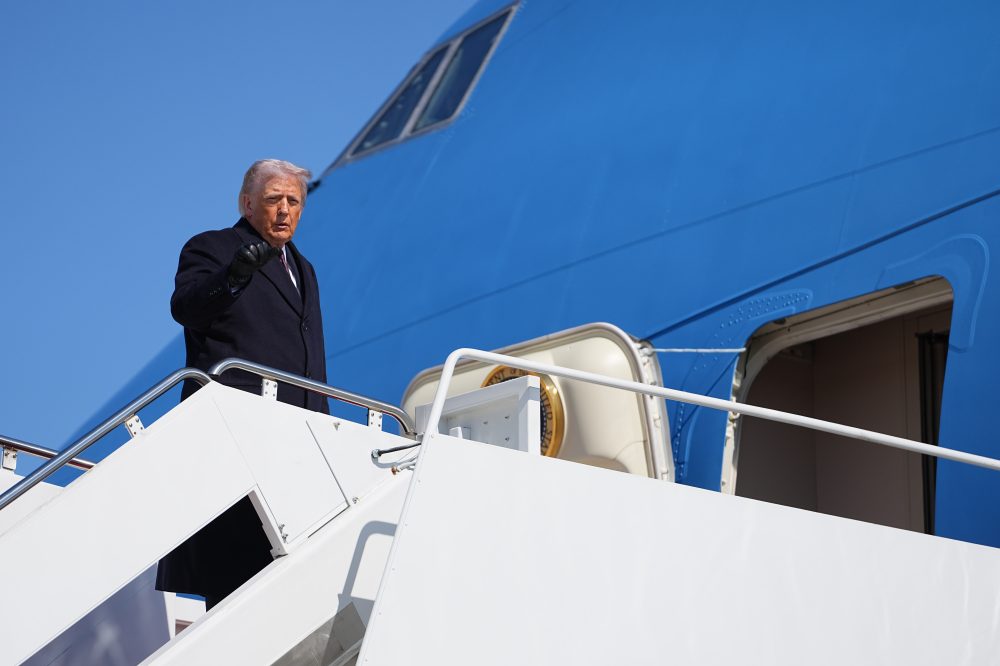
While traveling on Air Force One to Texas events at 3:38 p.m. EST, Trump authorized the military action dubbed “Operation Epic Fury.”
“The president directed, and I quote, ‘Operation Epic Fury approved … Good luck,’” General Dan Caine, chairman of the Joint Chiefs of Staff, revealed during a Monday press conference.
According to Caine, this authorization triggered final preparations across all joint U.S. military branches, with air defense systems positioning themselves and flight crews conducting last-minute rehearsals of their attack plans. Simultaneously, aircraft began receiving final armaments while two U.S. carrier strike groups moved toward launch positions.
During his continued flight to Texas, Trump made multiple Truth Social posts, including one nine minutes after approving the strike that ordered the government to cease using Anthropic artificial intelligence technology following a public disagreement between the company and Pentagon regarding AI safety measures.
Upon arriving in Texas at 4:03 p.m. EST, Trump addressed reporters at the Port of Corpus Christi about the negotiations, reiterating his displeasure without revealing the approved operation. When asked about his proximity to deciding on strikes, he declined to answer.
“I’d rather not tell you,” Trump responded. “You would have had the greatest scoop in history, right? Yeah.”
The actual military action commenced at 1:15 a.m. EST, based on Caine’s Monday timeline presentation.
“Across every domain — land, air, sea, cyber,” American forces “delivered synchronized and layered effects designed to disrupt, degrade, deny and destroy Iran’s ability to conduct and sustain combat operations on the U.S. side,” Caine explained.
During the Pentagon briefing, Caine described the operation as involving “thousands of service members from all branches, hundreds of advanced fourth- and fifth-generation fighters, dozens of refueling tankers, the Lincoln and Ford carrier strike group and their embarked air wings.”
He emphasized that ammunition and fuel supplies maintained continuous flow with support from an extensive network including intelligence and surveillance operations, while additional forces continued deploying to the region.
The military action followed months of CIA efforts to monitor senior Iranian leadership movements, particularly Supreme Leader Ayatollah Ali Khamenei. This intelligence was shared with Israel, leading to adjustments in Saturday’s strike timing, according to an anonymous source familiar with the operation.
In Tehran, explosions were audible as Israel’s defense minister announced a state of emergency.
Three coordinated strikes at separate locations occurred within sixty seconds, eliminating Khamenei and approximately 40 senior officials, including the paramilitary Revolutionary Guard commander and Iran’s defense minister, an Israeli military official confirmed.
At 4:37 p.m. EST, Trump used his Truth Social platform to announce Khamenei’s death, stating the supreme leader was “unable to avoid our Intelligence and Highly Sophisticated Tracking Systems.”
On Sunday at 12:21 p.m. EST, Trump posted on Truth Social that American forces had “destroyed and sunk 9 Iranian Naval Ships,” would be “going after the rest” and “largely destroyed their Naval Headquarters.”
Later Sunday at 4:06 p.m. EST, the Republican president released a video message stating that U.S. military and allies struck hundreds of Iranian targets, including Revolutionary Guard installations and air defense systems “all in a matter of literally minutes.”
Trump indicated the strikes would persist until “all of our objectives are achieved” without specifying those goals.
Also Sunday, Trump administration officials informed congressional staff during private briefings that U.S. intelligence had not indicated Iran was planning a preemptive attack against America, according to three briefing participants.
Instead, administration officials acknowledged a broader regional threat from Iran’s missile capabilities and proxy forces, two sources reported.
A senior White House official also stated Sunday that Iran’s “new potential leadership” had expressed openness to discussions with the United States.
In a Sunday New York Times interview, Trump suggested the assault could continue for “four to five weeks.”
Monday at 8 a.m. EST, Defense Secretary Pete Hegseth clarified during a Pentagon briefing that the U.S. was not pursuing nation-building in Iran and that continued strikes would not lead to prolonged conflict.
“This is not Iraq. This is not endless,” he stated. “This is not a so-called regime change war, but the regime sure did change, and the world is better off for it.”
During Monday trading, oil prices surged as tanker disruptions near the Strait of Hormuz sparked concerns about Persian Gulf supply shortages. U.S. oil reached approximately $71.97 per barrel. MarineTraffic.com reported that strait transit had decreased 70% since Saturday.
The strikes also unsettled global markets, with U.S. futures following European and Asian markets downward. Both S&P 500 and Dow Jones Industrial Average futures dropped roughly 1%.