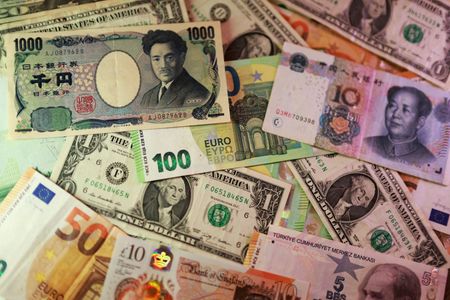

The U.S. dollar gained significant ground Wednesday, riding a sharp overnight surge in Treasury yields that sent the Japanese yen tumbling to its lowest value in 40 years.
The dollar climbed to a new peak of 162.77 yen during early Asian trading hours — a level that surpasses the thresholds that previously prompted Japanese authorities to step in and support their struggling currency.
Chidu Narayanan, head of macro strategy for APAC at Wells Fargo, suggested that another round of intervention could be on the horizon. “We believe we are close to potential action,” he said. “We are at crucial levels, not necessarily in terms of a target spot level, but levels where the (Ministry of Finance) might need to intervene to retain its credibility.”
Some traders are eyeing the upcoming U.S. public holiday on Friday as a possible opportunity for Tokyo to purchase yen, since lower trading volume during that period could amplify the effect of any intervention effort.
Across the broader currency markets, the dollar was on the offensive. The euro dipped 0.07% to $1.1413, while the British pound slipped 0.09% to $1.3252. Measured against a basket of major currencies, the dollar held steady at 101.24.
The greenback’s strength followed a significant intraday jump of 9 basis points in the 10-year U.S. Treasury yield on Tuesday, which ultimately closed the session about 4.8 basis points higher. The 2-year Treasury yield also rose 3 basis points, last sitting at 4.1702%.
Analysts noted there was no single obvious driver behind the yield moves, though some of the activity may have been tied to end-of-month portfolio adjustments.
With Thursday’s U.S. nonfarm payrolls report on the horizon, data released overnight showed that U.S. job openings edged up to their highest level in two years during May. However, sluggish hiring has dampened workers’ confidence in the job market.
Ray Attrill, head of FX strategy at National Australia Bank, said the labor market continues to send a clear signal to the Fed. “All the evidence and the Fed’s view itself is that the labour market is proving to be resilient, and therefore in terms of the Fed’s dual mandate, the labour market is clearly not giving any signal that they should be thinking about cutting rates,” he said.
According to the CME FedWatch tool, traders now see a 67% probability that the Fed will raise rates in September — a dramatic jump from just 20.5% a month ago.
Prashant Newnaha, senior rates strategist at TD Securities, warned that the window for inaction is narrowing. “The runway is certainly getting shorter for those advocating for no policy change when the Fed’s stance is viewed to be hawkish, inflation is well above target and U.S. data is beating expectations,” he said.
Markets were also keeping an eye on Fed Chair Kevin Warsh’s scheduled appearance at the European Central Bank Forum on Central Banking in Portugal. NAB’s Attrill tempered expectations for any major announcements, saying, “There’s probably as much focus on whether he might say anything, but I think he probably won’t, given his lack of interest in offering any forward guidance (in June).”
In other currency moves, the Australian dollar fell 0.18% to $0.6907, while the New Zealand dollar edged down 0.04% to $0.5674.