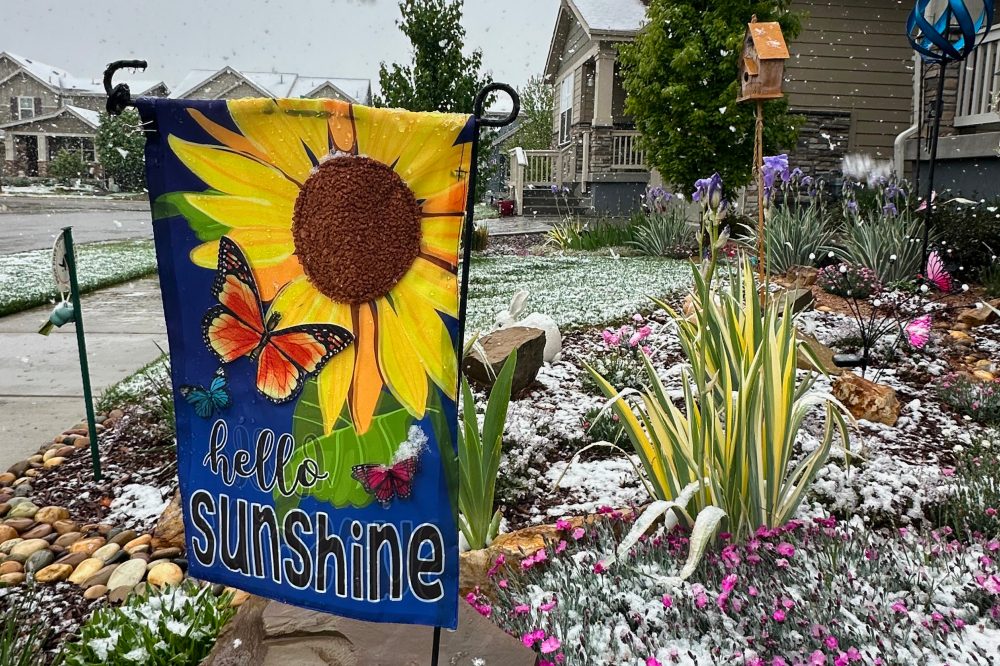

While many Americans across the country are enjoying spring weather and tending to their gardens, residents of Colorado and Wyoming are dusting off their snow shovels for what could be a significant late-season storm.
A major weather system is approaching the Rocky Mountain region and High Plains, initially bringing rainfall that forecasters expect will transition to snow in the Denver metropolitan area by Tuesday evening. The National Weather Service predicts accumulations could reach 8 inches, with mountainous areas potentially receiving up to 12 inches of snowfall.
This storm has the potential to become Denver’s most substantial snowfall of the entire winter season.
“We just had our driest winter on record,” said Kenley Bonner, a meteorologist with the National Weather Service’s Denver office. “We were kind of joking earlier in the season that winter’s not going to come until spring, and it did exactly that.”
Weather officials warn that snowfall will persist through Wednesday, followed by dramatically dropping temperatures and widespread freezing conditions overnight.
The heavy, moisture-laden snow poses risks for downed tree limbs and electrical outages, Bonner cautioned. Power companies are taking precautionary measures, with Xcel Energy placing 165 workers on emergency standby throughout Colorado.
While uncommon, such late-season weather events aren’t unprecedented for the region.
Denver’s average final snowfall typically occurs around April 28, though May snowstorms do occur periodically. The city recorded half an inch of snow on May 21, 2022, while the nearby community of Boulder received 4.5 inches during that same event.
Weather records show Denver has experienced at least five May snowstorms producing more than 10 inches of accumulation. The most severe occurred in 1893, delivering 15.5 inches. The city’s most recent double-digit May snowfall happened on May 25-26, 1950, when 10.7 inches fell.
The latest recorded snowfall in Denver occurred on June 2, 1951, though it was only a light dusting.
Last month brought above-normal temperatures and below-average precipitation to the area, with Denver receiving one inch less rain and 2.8 inches less snow than typical April totals.
However, this single weather event won’t address the broader water shortage challenges facing western states.
According to a recent assessment from the National Drought Mitigation Center, while recent moisture has improved surface soil conditions and reduced irrigation needs, the overall water supply outlook remains “mostly bleak” heading into summer months.
The unstable weather pattern extends beyond the Rocky Mountain region.
Severe thunderstorms are forecast from northeastern Texas through western Tennessee, with Arkansas facing the highest probability of large hail, destructive winds, and potential tornado activity, according to the Storm Prediction Center. Some strong storms may also develop across portions of the Northeast.