
The progressive movement within the Democratic Party may have already reached its peak in the 2026 midterm cycle — or it could be just getting started. The answer depends on who you ask inside a party that is clearly divided between emboldened left-wing activists demanding sweeping change and a cautious establishment focused on winning in November.
Progressive leaders are expecting their newest candidate in Maine, former state lawmaker Troy Jackson, to lock up the Democratic nomination Saturday to take the place of Graham Platner on the fall ballot. Platner was forced off the ticket earlier this month amid controversy. Looking ahead, August Senate primaries in Michigan and Minnesota will put the party’s internal split on full display — with all three states playing a critical role in the battle for Senate control.
“We’re seeing the pendulum shift from right to left. That’s ultimately what this midterm election is about,” said Joseph Geevarghese, who heads Our Revolution, the progressive organization that Vermont Sen. Bernie Sanders launched a decade ago. “We’re in a transitional moment in national politics.”
On the other side of the aisle within the same party, Democratic leaders in both the House and Senate believe the surge of progressive energy this summer will ultimately cost the party in the general election. Democrats are well-positioned to flip at least one chamber of Congress, given President Donald Trump’s low approval ratings, an unpopular war in Iran, and rising costs for everyday Americans.
Matt Bennett, a co-founder of the centrist Democratic group Third Way, is among those sounding the alarm about what he sees as a dangerous leftward drift.
“It is an enormous mistake and an enormous risk for them to be engaged in an effort to push the party to the left,” Bennett said. He added that Sanders’ brand of far-left politics “is not what America is asking for.”
Voters will have the final say this fall, and the results could determine the ideological direction of the Democratic Party for a generation.
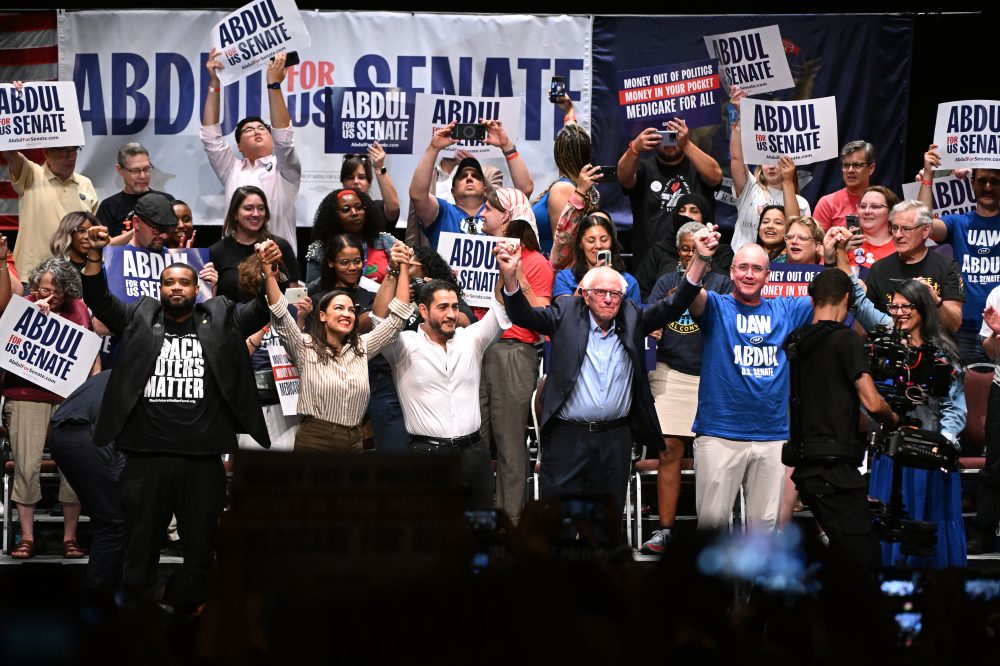
While establishment Democrats fret from Washington, Sanders and allies like Rep. Alexandria Ocasio-Cortez have been traveling through key swing states to energize the party’s grassroots base. Republicans, meanwhile, are watching the intraparty fight with satisfaction.
“Socialists have gone from a sideshow in the Democrat Party to the main event,” said Bernadette Breslin, a spokesperson for the National Republican Senatorial Committee.
On Monday evening in Minneapolis, Sanders drew a sharp contrast between working people and the ultra-wealthy as he campaigned alongside Peggy Flanagan, Minnesota’s lieutenant governor, who has embraced his populist message in a contentious Senate primary.
“When you stand up to these billionaires, as you will, and when you defeat them, you will bring hope and inspiration to people all across our country and in fact, all over the world,” Sanders told the crowd.
Flanagan is facing U.S. Rep. Angie Craig, who has the backing of much of the party’s establishment in a race that has attracted millions of dollars from super PACs and outside groups supporting both candidates.
“I want you to know that we have an opportunity to change the way that Washington works,” Flanagan told supporters.
The rally concluded with Sanders, Flanagan, U.S. Rep. Ilhan Omar, and retiring Sen. Tina Smith linking arms as John Lennon’s “Power to the People” blasted from the speakers.
A similar scene played out the day before in Michigan, where Sanders, Ocasio-Cortez, and other progressive figures campaigned with Abdul El-Sayed — a candidate many centrist Democrats fear is too far to the left for a seat they must win in a battleground state.
Dozens of progressive candidates across the ballot who are aligned with Sanders, including more than 30 backed by the Democratic Socialists of America, have secured Democratic nominations in recent weeks — in some instances defeating sitting members of Congress.
Still, the movement has faced setbacks, with none more damaging than the collapse of Platner’s campaign in Maine. Platner, a political newcomer and Sanders supporter who had beaten Maine’s sitting governor in the Democratic Senate primary, was forced to withdraw barely a week ago after a former girlfriend alleged sexual assault. Platner denied the accusation, though several allies said they found it credible.
Geevarghese called the situation “a bump in the road” that would not cause lasting harm to the broader progressive cause.
Rep. Ro Khanna, D-Calif., a potential 2028 presidential contender aligned with the progressive wing, admitted he made an error by endorsing Platner before enough was known about his background.
“It’s an important lesson of being more aware of the red flags of candidates,” Khanna said, while maintaining that the progressive movement “is so much bigger than any individual.”
“Despite a very flawed candidate, the platform of Medicare for all and no foreign wars and taxing billionaire wealth was so strong that he did well,” Khanna said of Platner. “No one candidate is a test for the progressive movement.”
Nevertheless, the fallout from Platner’s campaign has reignited a longstanding debate among establishment Democrats about whether the progressive wing is hurting the party’s ability to win competitive races in November. The divide has been particularly visible in the Senate, where some members have backed progressive candidates against the wishes of party leadership. Platner’s collapse triggered behind-the-scenes blame and prompted some establishment figures to step more actively into other contested primaries.
In Michigan, for example, Sen. Gary Peters endorsed Haley Stevens last week after previously indicating he would stay out of the race.
“We do want to have candidates who are fully vetted running in these high-profile races,” Peters said.
Bennett of Third Way says the bottom line is winning in November. He acknowledged that a progressive nominee like El-Sayed could still pull off a victory in Michigan given the political climate.
“In this cycle, with the war raging again, anyone might be able to beat a Republican in a place like Michigan,” he said. “But it sure as hell is going to be harder.”