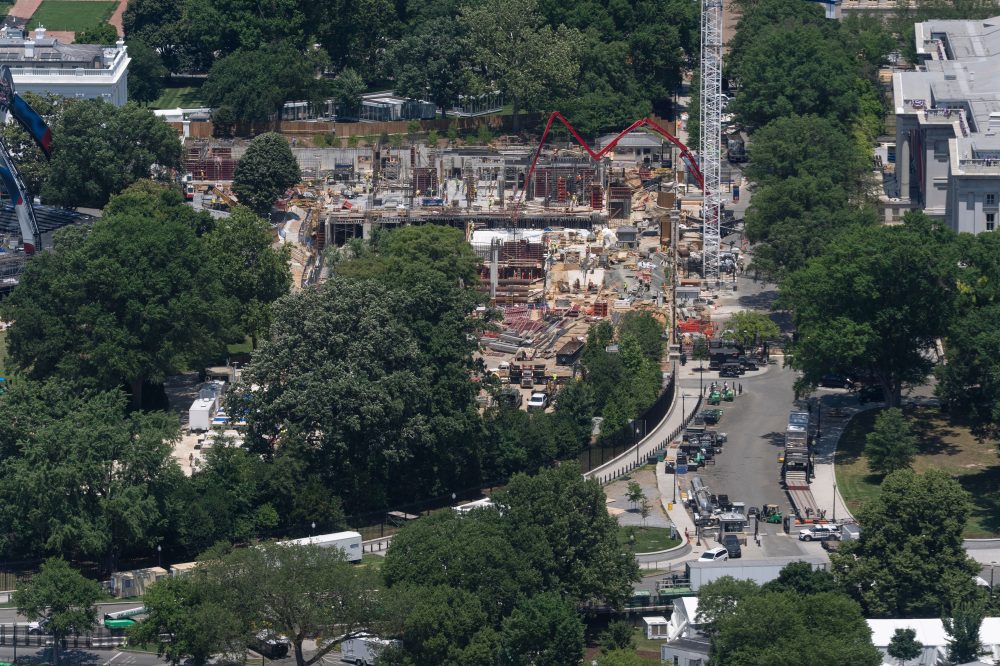

WASHINGTON — Over $350 million drawn from President Donald Trump’s sweeping tax and spending cuts legislation has been quietly funneled toward White House security — and Democrats are charging that the money is being used to help pay for the president’s new ballroom project, despite his repeated promises that taxpayers wouldn’t foot the bill.
The funds were directed by the White House’s Office of Management and Budget late on a Friday, pulled from two accounts originally set aside to give the U.S. Secret Service additional resources for hiring and training following last year’s assassination attempts on the president. That’s according to Democrats on the Senate Budget Committee. The move came just days after Congress rejected a $1 billion White House funding request that had been attached to a Homeland Security bill Trump signed into law, and as the ballroom project faces ongoing legal challenges.
Senate Judiciary Committee Chairman Chuck Grassley, whose committee originally drafted the security funding language, said Thursday he had no knowledge of where the money was being directed.
“The president said that it was all going to be paid for with private money,” said Grassley, R-Iowa. “And that’s what the country expects.”
Sen. Jeff Merkley of Oregon, the leading Democrat on the Senate Budget Committee, went further, calling Trump’s actions potentially illegal.
“After repeatedly telling the American people that zero taxpayer dollars would be spent on his gold-plated ballroom boondoggle, now Trump appears to be using a smoke and mirrors tactic,” Merkley said in a statement.
“Trump has proven that he can’t be trusted to follow the law,” Merkley added. “He only cares about wasting taxpayer money on his vanity projects.”
The president has run into obstacles in his effort to construct the ballroom on White House grounds, which required demolishing the historic East Wing to make room for it. During a visit to the construction site last month, Trump described the development as a “gift” to the American people, maintaining it would be covered entirely through private donations — a claim that has itself drawn scrutiny from ethics watchdogs who have raised concerns about potential corruption and conflicts of interest.
Congress shot down the administration’s $1 billion funding request for the project last month after attempts to attach it to a Homeland Security spending bill were rejected by both Republican and Democratic lawmakers. The request became a political liability at a time when many Americans are struggling with the high cost of living.
The Washington Post reported earlier this week that the total cost of the project has grown to $600 million, according to a summary prepared by the contractor, with taxpayers covering more than half of that amount. Roll Call was the first to report on the newly redirected security funds.
At the heart of the dispute is a disagreement over what portion of the White House project is truly about security — including underground bomb shelters and a medical facility — versus what portion is tied to the president’s promised 999-seat ballroom above ground.
A White House spokesman pushed back on the criticism, saying Trump and private donors are contributing roughly $400 million toward the ballroom, and that the involvement of the Secret Service had been disclosed from the start of the project.
“The East Wing Modernization Project is inextricably tied to the security of the President, the White House grounds and the certain security infrastructure assets,” White House spokesman Davis R. Ingle said in a statement.
Ingle also pointed to events from the past weekend — including an alleged plot targeting the UFC Freedom 250 event held at the White House — as evidence of why the project is necessary.
“President Trump and generous American patriots are funding the ballroom to the tune of approximately $400 million, which will be a secure and appropriate venue for Presidents for generations to come,” he said.
Government lawyers have argued in court that the project incorporates critical security measures designed to defend against threats including drones and missiles. Court documents filed by the White House describe the East Wing project as “heavily fortified,” featuring bomb shelters, military installations, and a medical facility beneath the ballroom. The Secret Service told senators last month that $220 million of the original $1 billion request would go toward hardening the ballroom addition with bulletproof glass, drone detection systems, and chemical protection technology.
The remaining funds, according to a document shared with Senate Republicans, would cover other security upgrades — including $180 million for a new, “long overdue” visitor screening facility at the White House.
The redirection of these funds is expected to intensify an ongoing debate in Congress over the separation of powers and whether the president is appropriately using money that lawmakers designated for specific purposes.
The funds originate from Trump’s major tax cuts and spending reductions bill, which the president signed into law last summer. That legislation included more than $1 billion earmarked for Secret Service resources, covering “personnel, training facilities, programming, and technology; and performance, retention, and signing bonuses.”
That provision drew no opposition at the time it was written — even though Democrats voted against the broader bill. Democrats acknowledged they did not attempt to strip out or challenge that particular section of the legislation.
Under the U.S. Constitution, the authority to allocate federal funds rests exclusively with Congress, covering operations across the executive and judicial branches. While the president can sign or veto spending bills, once funding is enacted into law, it is largely required to be used as Congress intended.