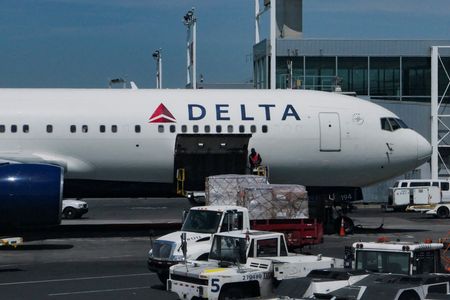

Delta Air Lines announced Wednesday it’s abandoning all expansion plans for the upcoming summer travel season as skyrocketing fuel costs squeeze the airline industry.
The Atlanta-headquartered carrier revealed it’s eliminating planned capacity increases for the June quarter, reducing available flights by approximately 3.5 percentage points compared to original projections. Company executives stated that expansion efforts now face a “downward bias until the fuel environment improves.”
The airline’s revised outlook underscores mounting pressure across the aviation sector as Middle East tensions have sent energy markets into turmoil. Jet fuel prices have nearly doubled since late February, creating the industry’s most significant challenge since recovering from the pandemic.
Some optimism emerged Tuesday when President Donald Trump announced a two-week ceasefire agreement with Iran had been reached.
Despite the fuel concerns, Delta’s stock jumped 12% in early trading after reporting first-quarter earnings that exceeded expectations. Competing airlines United, American, and Southwest also saw shares climb 9% to 11% as investors reacted positively to potential fuel price relief and Delta’s strong quarterly performance.
Fuel expenses typically represent about 25% of airline operational costs, making carriers vulnerable when prices surge faster than they can adjust ticket prices, especially since seats are often sold months ahead of travel dates.
The current crisis threatens to reshape the industry landscape, potentially forcing weaker airlines to slash routes, increase borrowing, or face substantial losses while financially stronger competitors maintain investments and capture market share.
Delta Chief Executive Ed Bastian cautioned that rising fuel expenses will accelerate industry-wide changes.
“It’s going to separate the winners and force the weaker players to take some pretty significant steps to either get better or something else will happen,” Bastian stated.
United Airlines CEO Scott Kirby has indicated his company is preparing for Brent crude oil to potentially reach $175 per barrel and stay above $100 through 2027.
Airlines are responding by cutting flight schedules, especially on less profitable routes and non-essential business travel. Since mid-March, domestic carriers have reduced planned capacity growth by more than half a percentage point.
Delta projects adjusted earnings between $1.00 and $1.50 per share for the June quarter. The midpoint estimate of $1.25 falls short of analyst predictions averaging $1.41 per share.
The carrier anticipates paying roughly $4.30 per gallon for jet fuel during the second quarter, adding more than $2 billion to fuel expenses compared to the same period last year.
Airlines have leveraged robust travel demand to offset some increased fuel costs through higher ticket prices, baggage fees, and additional charges.
Bastian indicated Delta plans to recover approximately 40% to 50% of elevated fuel costs in the second quarter through fare increases, though he acknowledged full cost recovery will require more time.
The airline expects a $300 million boost from its refinery operations in the second quarter, up from about $60 million in the March quarter as refining profit margins expanded.
Tuesday brought news that Delta will increase checked baggage fees, matching recent moves by United and JetBlue Airways.
Bastian suggested the higher fees may become permanent. “At this level of fuel, it’s hard to call anything temporary,” he explained.
The CEO dismissed concerns that increased fares and fees might reduce demand, noting ticket sales have grown at double-digit rates year-over-year during the past month, with strong momentum continuing into the second quarter.
He emphasized that affluent travelers remain resilient and Delta hasn’t observed any demand impact among higher-income customers.
For the March quarter, Delta reported adjusted earnings of 64 cents per share, surpassing analyst expectations of 57 cents.
While Delta previously forecast full-year adjusted earnings between $6.50 and $7.50 per share in January, Bastian declined to update guidance given current market uncertainty. Analysts now project $5.40 per share.