
A Delaware farmer has earned national recognition for his commitment to environmental stewardship and sustainable farming practices.
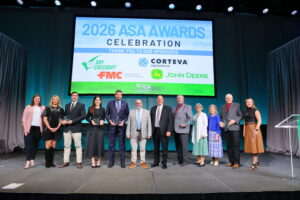
James “Jay” Baxter received the 2026 Northeast Regional Conservation Legacy Award from the American Soybean Association at the recent Commodity Classic conference. The honor celebrates farmers who demonstrate excellence in protecting natural resources while maintaining productive operations.
Baxter was one of four regional winners selected from across the United States, with Tennessee farmer Alex Forsbach taking home the top national prize.
The Delaware farmer’s recognition comes from his dedication to practices that protect water quality in his community. Baxter employs no-till farming methods, plants cover crops, and carefully manages nutrients to prevent runoff from reaching local waterways.
“This isn’t just about our farm, it’s about our community and the resources we all share,” Baxter explained during the awards ceremony.
His farming philosophy extends beyond immediate productivity gains to long-term environmental responsibility.
“At the end of the day, we want to leave this land better than we found it,” he stated.
Baxter’s approach reflects the unique challenges faced by farmers in Delaware, where agricultural decisions directly impact surrounding communities and shared natural resources.
The national winner, Alex Forsbach from Tennessee, has dedicated more than ten years to developing conservation systems based on patience and consistency. His operation focuses on no-till practices and cover crops, which have gradually improved his soil’s organic matter, structure, and ability to retain moisture.
“It doesn’t happen overnight,” Forsbach noted. “You have to stay consistent and trust the process.”
As the top honoree, Forsbach emphasized the importance of knowledge sharing among farmers.
“If we want to keep farming strong into the future, we have to be willing to learn and help others along the way,” he said.
The other regional winners included Lewis Unruh from Kansas, who won the Midwest Regional Award, and Jon and Cathy Nelson from South Dakota, who captured the Upper Midwest Regional Award.
Unruh continues a family tradition of conservation that began with contour farming to prevent erosion. His current operation incorporates no-till methods, cover crops, and enhanced water management systems.
“We’ve always believed that if you take care of the soil, it will take care of you,” Unruh shared.
The Nelson family from South Dakota built their award-winning operation on adaptability and continuous learning. Their farm features no-till practices, varied crop rotations, and techniques specifically designed to build soil health over time.
“You have to be willing to try things, learn from them, and keep adapting,” Jon Nelson explained.
The couple also believes in sharing successful practices with other farmers. “If something works for us, we want to share it,” Cathy Nelson said. “That’s how agriculture moves forward.”
The Conservation Legacy Awards program was established to honor farmers who enhance their operations while safeguarding the natural resources essential to their success. The American Soybean Association runs the program with support from industry partners including BASF, Bayer, Nutrien, Valent USA, and the United Soybean Board through soy checkoff funding.
A national committee comprising farmers, conservation experts, agronomists, and natural resource professionals evaluates all applications. Each year, the program recognizes regional leaders and selects one national winner whose operation exemplifies conservation excellence.
Common practices among all winning operations include prioritizing soil health through no-till farming and cover crops that prevent erosion and enhance soil structure. Water management remains crucial, whether through contour farming or careful nutrient application. Precision technology helps farmers apply inputs more efficiently.
Beyond specific techniques, these farmers share a mindset focused on building systems that improve over time.
As agriculture confronts challenges including narrow profit margins, increasing input costs, and growing sustainability expectations, these award winners deliver an important message: conservation practices complement rather than compete with productivity goals.
For the 2026 Conservation Legacy Award recipients, recognition at Commodity Classic represents a significant achievement. However, their real work continues in their fields, season after season, as they demonstrate that environmental stewardship forms the foundation of agriculture’s future.