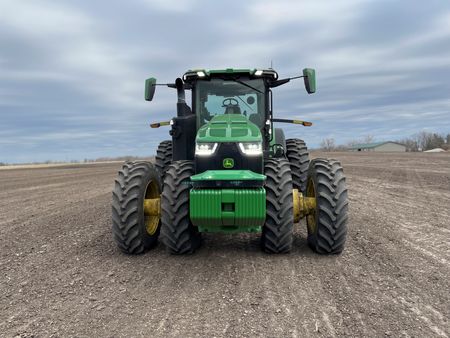

Agricultural machinery manufacturer Deere maintained its annual earnings outlook despite surpassing second-quarter profit projections on Thursday, as the company continues grappling with persistently soft demand for large farming equipment.
Equipment manufacturers including Deere have struggled with subdued interest in new agricultural machinery in recent years, as poor crop prices and increased operational expenses have prompted farmers to delay replacing their existing equipment.
Projections show U.S. net farm income, a key indicator of agricultural sector health, is anticipated to decline 0.7% in 2026.
Company shares dropped 7.5% to their lowest point in four months and appeared headed for their steepest single-day decline in four years.
“While encouraged by the upside to the construction segment, investors are still looking for signs of recovery in the agriculture segments, which remains a mixed bag globally,” Oppenheimer analyst Kristen Owen said.
The company maintained its annual net income projection at $4.5 billion to $5 billion, primarily due to continued weakness in farm equipment sales. Deere executive Christopher Seibert attributed this to “elevated and volatile input costs” for farmers due to the U.S.-Israel war with Iran.
This development overshadowed an otherwise solid second quarter where both earnings and sales exceeded analyst predictions, driven by stronger demand for the company’s smaller agricultural and construction machinery.
The construction division has emerged as a standout performer, capitalizing on AI-driven data center expansion.
The company now anticipates construction segment annual revenue will increase 20%, higher than its previous 15% growth projection, with yearly operating margins of 10%-12%, up from the earlier estimate of 9%-11%.
Quarterly earnings reached $6.55 per share, beating the average analyst expectation of $5.70 per share according to LSEG data. Quarterly sales of $11.78 billion exceeded the projected $11.54 billion.
The company received a $272 million tariff refund this quarter, though it anticipates the annual impact will remain consistent with previous expectations.