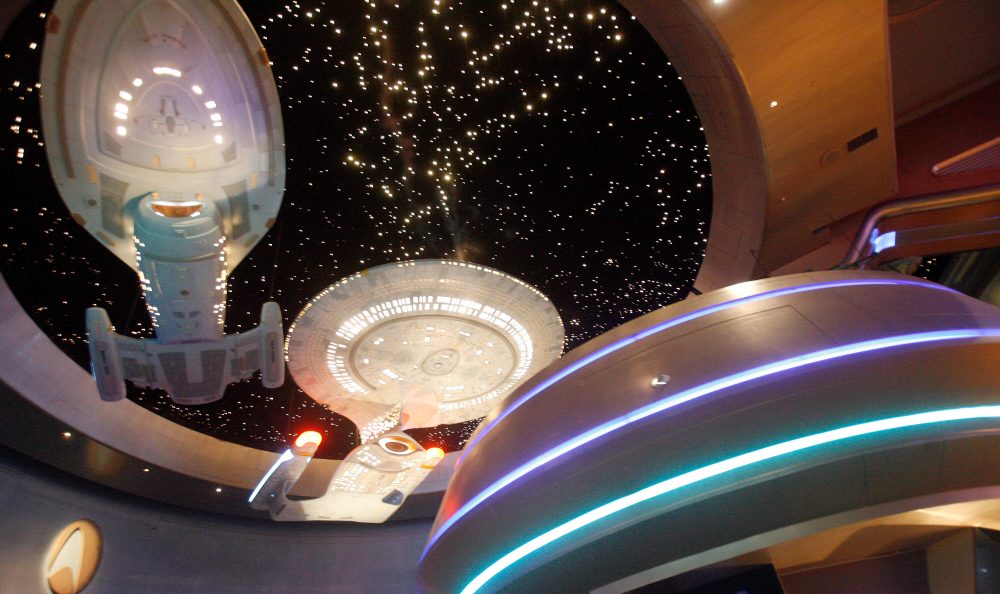

Long before the undead dominated horror films, extraterrestrial visitors commanded the spotlight in movie theaters, drive-in cinemas, and late-night television programming across America.
While Hollywood continues to influence how Americans picture otherworldly beings with oversized heads and eyes, the line between fantasy and reality may soon become clearer if federal agencies follow through on President Donald Trump’s February directive to declassify confidential documents about UFOs and extraterrestrial encounters.
Science fiction cinema has fundamentally influenced public perception of intelligent beings from other worlds, according to Duke University professor Priscilla Wald, who instructs students on science fiction and film. She explains the genre presents various scenarios: “whether it’s invasion narratives or aliens coming to warn us that we’re on the wrong track or aliens just trying to come and make contact and help us with things or just say ‘hi.’”
Trump’s social media declaration came after former President Barack Obama hinted during a podcast that extraterrestrial life might be real. Obama subsequently explained he hadn’t witnessed proof of alien contact but noted that given the universe’s immense size, life likely exists beyond our planet.
Cinema has depicted alien encounters in diverse American locations, from Pennsylvania farmland in “Signs” (2002) to Wyoming’s Devil’s Tower in “Close Encounters of the Third Kind” (1977) and Central American wilderness in “Predator” (1987).
Retired Navy Rear Admiral Timothy Gallaudet believes cinema has served an important preparatory function. “Hollywood has basically been preparing the public for this,” he states regarding potential confirmation that intelligent extraterrestrial life exists and has reached Earth. “I think people can handle it. It does, of course, depend on what information is released (by the government).”
The entertainment industry rapidly capitalized on the 1947 Roswell, New Mexico incident, where officials first described recovered debris as belonging to a flying disc before revising their explanation to claim it came from a weather balloon experiment.
Approximately three years following Roswell, “The Flying Saucer” reached cinemas. This was succeeded by numerous low-budget, largely forgotten productions, though some films like 1951’s “The Day the Earth Stood Still” continue captivating science fiction enthusiasts today.
Wald notes the timing of this cinematic trend: “If you think back to the flourishing of alien films, this starts really in the U.S. in the 1950s.”
Describing “The Day the Earth Stood Still,” she explains: “The aliens are gentle souls who come down and try to warn us after nuclear war. They’re trying to warn that we’re creating problems in the cosmos and that if we don’t stop, they are and have to do something about it.”
Conversely, other films portray visitors with hostile agendas, seeking to eliminate humanity, conquer our planet, or even use humans as sustenance.
Wald anticipates mixed public reactions to confirmed alien contact: “I think if we found out aliens were on the way, there would be a mix of responses. I think there would be a lot of people out there welcoming them. A lot of people would be going down to the cellars and stocking them with canned food.”
Documentary filmmakers have also explored this subject extensively, including 2025’s “The Age of Disclosure,” which examines government awareness of non-human intelligence and efforts to study alien technology.
Director Steven Spielberg created successful films including “E.T. The Extra-Terrestrial” (1982) and “Close Encounters of the Third Kind.” His forthcoming movie “Disclosure Day” poses the question: “If you found out we weren’t alone, if someone showed you, proved it to you, would that frighten you?”
Wald reflects on the underlying psychology of alien fear: “My question is always, ‘Well, what is that fear really about?’ It seems to me it’s a reflection on who we are, that we’re projecting onto aliens the way we treat each other. So, the aliens are coming down, they want to conquer us, they’re violent. Who does that sound like? It sounds like us.”