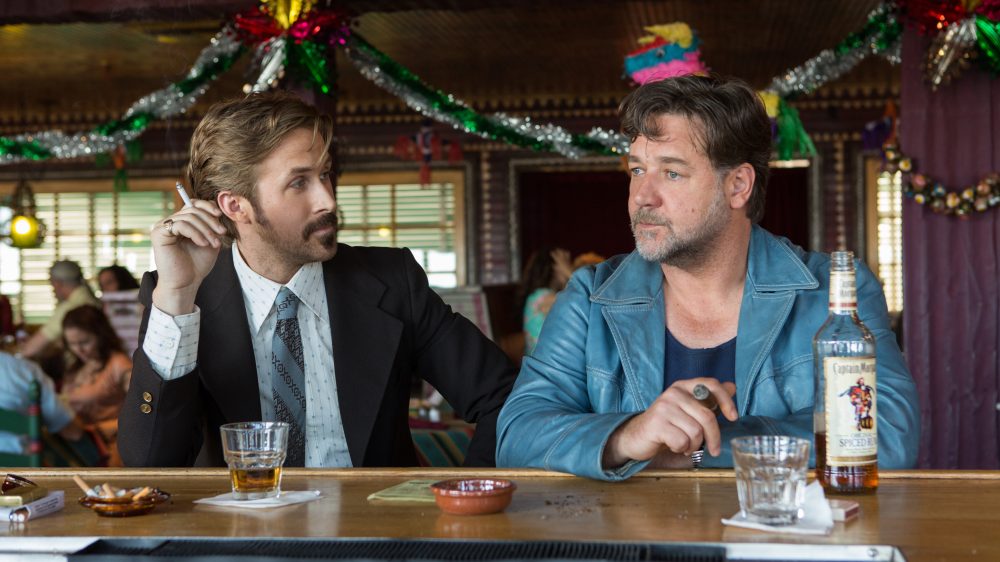

A decade ago, Ryan Gosling and Russell Crowe’s detective comedy faced a brutal theatrical release, squeezed between superhero blockbusters and defeated by animated birds at the box office. Today, that same film has transformed into one of the most cherished comedies of recent years.
“The Nice Guys,” which marks its 10th anniversary this month, suffered a disappointing debut when it hit theaters in 2016. Released between major franchise films like “Captain America: Civil War” and “X-Men: Apocalypse,” the Shane Black-directed comedy couldn’t compete with its opening weekend rival. “They’re just so angry,” Gosling once remarked about the cartoon birds that overshadowed their film.
Despite its initial commercial failure, the 1970s Los Angeles crime caper has found remarkable success in the streaming era. The film consistently ranks among Netflix’s most-watched content whenever it appears on the platform, introducing new audiences to Gosling’s comedic abilities that would later shine in “Barbie.”
“There’s a lot of interest in ‘The Nice Guys’ today that wasn’t there when it opened. And the box office will attest to that,” Black noted in a recent conversation. “But people find these things. I think there’s kind of a joy of finding a movie on streaming or rental and then suddenly kind of realizing: How did I miss this? And ‘The Nice Guys’ was easy to miss.”
Black, who created the “Lethal Weapon” franchise, has experienced both box office triumphs and cult classics. He’s grown to appreciate his commercially unsuccessful projects, including “Kiss Kiss Bang Bang,” which helped revitalize Robert Downey Jr.’s career a year before “The Nice Guys.”
“There’s something to being the king of the midnight movie,” Black explained. “It’s not the most lucrative thing in the world.”
The film’s theatrical struggles reflected broader industry changes. During the early 2000s, comedies dominated multiplexes with stars like Will Ferrell, Judd Apatow productions, and hits such as “The Hangover” and “Bridesmaids.” However, as franchise films gained prominence and international markets became crucial, studios abandoned theatrical comedies around the time Warner Bros. released “The Nice Guys” with its $50 million budget, earning approximately $71 million globally.
Recent years have seen comedies migrate primarily to streaming platforms, with Netflix’s Adam Sandler partnership representing an early strategic shift. Horror films largely replaced comedy as the preferred genre for theatrical releases.
Black developed the screenplay with Anthony Bagarozzi, drawing inspiration from classic detective fiction by authors like William Campbell Gault and Brett Halliday. His extensive reading in the genre has become almost supernatural in scope.
“I thought: There’s so much joy here,” Black reflected. “There’s so much fun in plot and twists and capers. You light a fuse and these guys go on this wild caper, and in the end, it’s just these two guys that are important. You can’t really remember the caper but it was there to service the idea, the shape of: These guys are at it again.”
The story pairs Gosling’s Holland March, a private investigator with an unusual handicap (he cannot smell), with Crowe’s Jackson Healy, an enforcer. Their partnership develops around a missing person case set against Los Angeles’s adult entertainment industry, with March’s perceptive young daughter Holly (Angourie Rice) joining the adventure.
The ensemble cast featured Kim Basinger, Keith David, and Margaret Qualley in an early significant role. However, the central dynamic between Gosling and Crowe drove the film’s success. Neither actor was particularly recognized for comedy at the time, with Crowe coming off the serious biblical drama “Noah.”
Black trusted his instincts about their partnership, following the comedy philosophy of writers Lowell Ganz and Babaloo Mandel from films like “Splash” and “Parenthood.”
“The thing is, Ryan is just a good actor,” Black observed. “He’s funny in everything he does. But he didn’t do a lot of outright comedies. For this, the character was not like a ‘Talladega Nights’ or ‘Step Brothers.’ It’s not that kind of comedy where everything is pushed. It was a story that an actor could do and basically play a real character.”
Black emphasizes character-driven comedy similar to “Midnight Run,” which successfully paired Robert De Niro and Charles Grodin. This approach contrasted with the high-concept comedies that dominated the few studio releases during that period.
“The Nice Guys” showcased Gosling’s physical comedy talents through elaborate pratfalls and slapstick sequences. One memorable scene features him attempting to balance multiple tasks while trapped in a bathroom stall, creating what Black describes as choreography worthy of Buster Keaton.
“My favorite that he walked in with one day was where he said, ‘I saw this movie last night with Abbott and Costello where they meet Frankenstein,’” Black remembered. “He said, ‘I’d like to maybe give that type of energy a try.’ When he said that, what he really meant was: I’m going to do a pitch-perfect Lou Costello impression sitting next to a tree for 60 seconds.”
Both leading actors embraced appearing foolish, cowardly, or incompetent on screen. “They wanted to be antiheroes,” Black noted. Crowe has praised the experience, particularly crediting Gosling as the only co-star who consistently made him break character during filming.
The inevitable sequel question frequently arises in Black’s interviews, though he acknowledges the challenging reality.
“It’s one of the most common questions I get,” Black admitted. “The answer, unfortunately, is nebulous.”
“You’re saying to a studio: Hey, we want to get these two big stars. It’s going to cost even more this time. You’re going to spend maybe twice the money on a sequel to a movie that didn’t get you what you wanted back,” he explained. “It’s a tough sell to take a movie that bombed and make a sequel.”
Despite these obstacles, Black remains enthusiastic about the possibility.
“Of course,” he responded when asked about his interest in a sequel. “This was designed for that. Like I said, it’s a caper. There’s these two and they get in a bunch of trouble and here they go again. You want to see them do it again. There’s a whole bunch of mystery capers you could throw at these guys. You could make a grounded, potentially very interesting, touching movie set not in the ’70s but perhaps in the ’80s.”
At the 2016 London premiere, Gosling playfully compared the event to cinema history.
“I wasn’t at the premiere of ‘The Godfather’ or ‘Apocalypse Now,’ but I got a feeling it felt pretty much the same as it does today,” Gosling declared. “You’re looking down the barrel of cinematic history.”
While Gosling spoke in jest, the film’s growing cultural impact suggests his prediction may not have been entirely wrong.