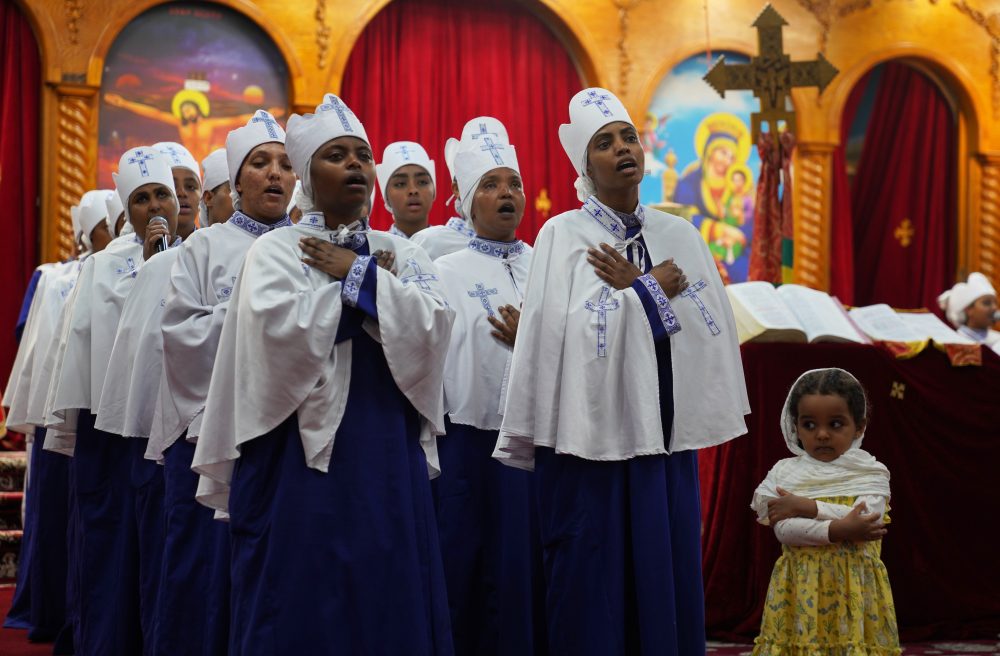

Clad entirely in white garments, approximately 1,500 Ethiopian Orthodox believers gathered at Washington DC’s DSK Mariam Church for their Easter observance, chanting hymns in the traditional Ge’ez language and maintaining an all-night prayer vigil.
Known as Fasika in the Amharic language, this celebration of Christ’s resurrection takes place one week following the Catholic and Protestant Easter observances.
“We dress in white so that we are groomed for heaven,” said Archdeacon Getahun Atlaw.
Within the Ethiopian Orthodox faith, Fasika represents the most sacred period of their religious calendar. Religious ceremonies intensify throughout Holy Week, reaching their peak with an eight-hour overnight worship service that concludes with ending a 55-day period of fasting from meat and dairy products.
This year brought additional challenges for some congregation members as Ethiopian communities across America confronted Trump administration attempts to eliminate temporary protected status affecting more than 5,000 Ethiopian nationals. A federal court has since prevented this action.
“It takes a grind and courage to get to where they’re at,” said 18-year-old deacon Jonathan Melaku of the members who founded the church. “Our people will always stay resilient.”
Ethiopian families have migrated to America over five decades, and the Washington congregation now includes both first and second-generation Ethiopian Americans.
“Ethiopians are hard workers, disciplined, mannered, and they know how to come together,” Atlaw said. “We’re not here merely, we bring values.”
The church, officially called Re’ese Adbarat Debre Selam Kidist Mariam Church, belongs to the Ethiopian Orthodox Tewahedo tradition, representing one of Christianity’s most ancient denominations.
Situated in the DC metropolitan region, which hosts America’s largest Ethiopian immigrant population, the congregation ministers to approximately 4,000 weekly attendees.
During this Easter season, roughly 1,500 people participated in the overnight worship that concluded at 3 a.m. Sunday morning.
“The climax is the resurrection because if there was no resurrection, there would be no Christianity. It would just be an empty philosophy,” said Abraham Habte-Sellassie, a “kesis” or priest — who helped lead the Divine Liturgy from midnight to 3 a.m., representing the three hours they believe Christ was on the cross.
Sebawit Yirsaw, who became a church member 16 years ago following her arrival from Ethiopia, explains that worshippers experience profound spiritual connection during Fasika because of their desire for redemption.
“The salvation is always something that we feel like much needed because we all go through a lot of hardship in life,” she said.
During Good Friday services earlier that week, clergy members gathered under dark purple and gold vestments symbolizing Christ’s victory over evil and offering of salvation. The religious leaders chanted together, “Lord have mercy upon me.”
At one moment during the ceremony, church officials extinguished a flame, symbolizing Satan’s defeat.
Throughout these services, both congregation members and clergy performed numerous prostrations.
“We’re living Christ-like as much as we can,” said Atlaw. “The prostration is a passion to Christ’s love. What he has done for us, the sacrifice.”
During the Easter midnight service, lighting is reduced while long, thin wax candles known as tuaf are illuminated to symbolize the resurrection moment when Christ’s light overcame darkness.
The sanctuary filled with voices as religious leaders and worshippers chanted together: “Your resurrection is for us who believe. Send your light upon us, send your light upon us.”
“The celebration is so joyful that you don’t even feel that you’re tired,” said 21-year-old Deacon Amanuel Argaw.
Following the Easter worship, congregation members hurried into the quiet pre-dawn streets, with birds singing softly, attracted by the aroma of doro wat, a traditional Ethiopian spicy chicken dish cooking with aromatic spices.
Standing in small clusters on the sidewalk, worshippers consumed small portions to end their fast before returning home to rest.
Throughout the day, families and friends assembled for Easter meals and completely ended their fast together while sharing doro wat and other customary Ethiopian cuisine.
Preserving these historic traditions in America and passing them to younger generations remains essential for community members.
“This history and value can go wherever Ethiopians go. This is our history. How can we take it lightly? … This is who we are,” said Atlaw. “We have to pass it from generation to generation.”
For Selamawit Tekola, ending the Easter fast alongside her extended Ethiopian family is non-negotiable.
“When Selama says, take off work and show up, it’s not optional,” joked Tekola’s niece, Adey Thomas, as they sat together in a house full of friends and family.
“In the States, it’s very, you know, rush to go, go, go especially in the D.C. area,” Thomas. “This is the one time to stop and celebrate with family.”
On a pleasant Easter Sunday in Virginia, the family gathered as requested. Wearing traditional attire, they assembled around homemade dishes and offered prayers. They shared traditional honey wine called Tej and later enjoyed Ethiopian coffee.
“I was born Orthodox and I respect it, I love it. So that means a lot for us.” said Tekola. “That’s what we are teaching our children.”