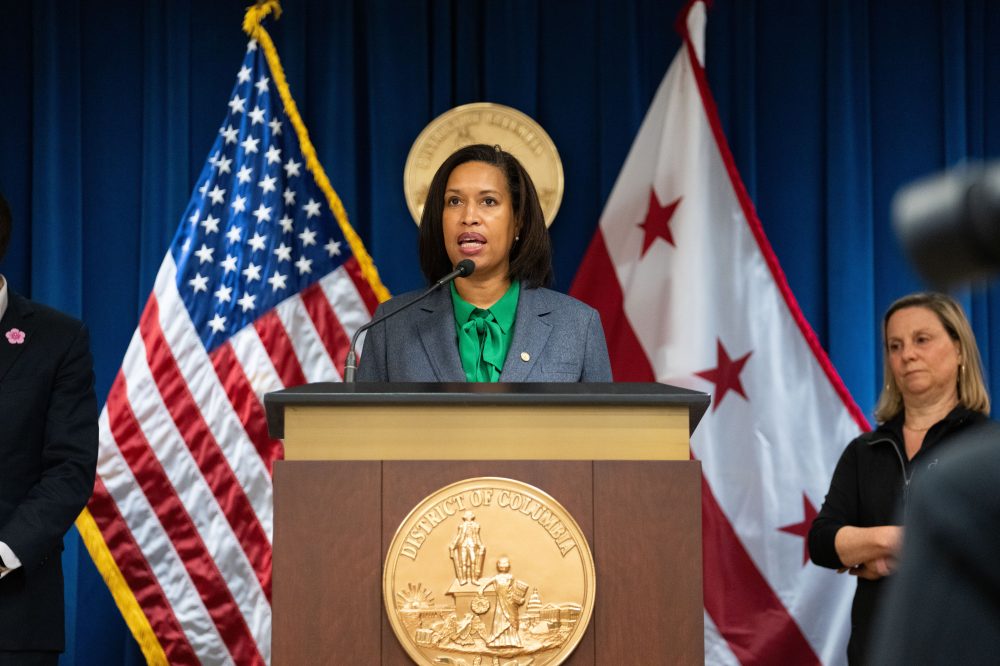

WASHINGTON (AP) — Mayor Muriel Bowser presented her final budget proposal on Friday before leaving office this year, outlining a $21.2 billion gross operating expenditure plan that’s expected to create significant debate among District Council members and on Capitol Hill, where GOP legislators have increasingly intervened in local matters.
The mayor’s financial plan prioritizes education and healthcare expenditures while reducing allocations in multiple sectors, including eliminating $127 million designated for upcoming union contract negotiations and salary increases for non-unionized municipal workers.
A significant aspect of the proposal involves reducing the general funds budget to $12.7 billion, representing a 3.3% decrease from 2026 levels. These general funds finance essential city operations. Bowser explained the reductions stem from declining revenues caused partly by federal employment cuts and increasing expenses, such as elevated Medicaid costs and higher administrative expenses for SNAP benefits due to federal law changes that transferred certain costs to state governments.
During her presentation to Council members, Bowser emphasized the city is “not broke” while describing what she characterized as three distinct phases of her leadership: periods of expansion, the COVID-19 economic crisis, and the post-pandemic recovery.
“We are adjusting to what DOGE has done to our workforce and commercial corridor,” she stated, referencing the Trump administration’s federal government downsizing efforts. She noted that increased expenses and reduced income have created an estimated budget shortfall requiring attention.
“I think we all have to be clear headed about where we are and what it will take to keep growing,” Bowser remarked. The mayor has led the city since 2015 and announced she won’t seek reelection this year.
Council members challenged Bowser and her team regarding proposed reductions, particularly criticizing cuts to programs designed to reduce childcare expenses in a city where families spend over $25,000 annually on average for infant care, according to Child Care Aware of America. The proposal would limit the District’s childcare subsidy program, which assists low-income families with care costs, to 6,000 children. Current subsidy recipients would maintain their benefits. The plan also eliminates a program that supplemented childcare worker wages, a pandemic-era initiative designed to attract and retain employees in a traditionally low-wage sector.
Council Chairman Phil Mendelson indicated the council would likely conduct a budget vote in June.
Washington’s financial planning has faced complications over recent years, including 2025 when the House approved federal funding legislation forcing the district to return to 2024 budget limits, effectively removing $1.1 billion from its balanced budget during the fiscal year.
The Department of Government Efficiency’s federal workforce restructuring significantly affected the Washington area. Terry Clower, who directs George Mason University’s Center for Regional Analysis, calculated that the region lost more than 50,000 positions. Clower explained these job losses extend beyond lost wages and income taxes, also impacting businesses serving those workers and creating additional revenue losses for local governments.
The D.C. Office of Revenue Analysis determined Washington experienced a net reduction of 22,000 federal positions with combined annual salaries exceeding $3 billion.
City Administrator Kevin Donahue identified revenue impacts from federal workforce reductions, primarily through the Department of Government Efficiency, which resulted in approximately $325 million in lost revenue from employment cuts and reduced consumer spending. These losses are projected to increase further in fiscal year 2027.