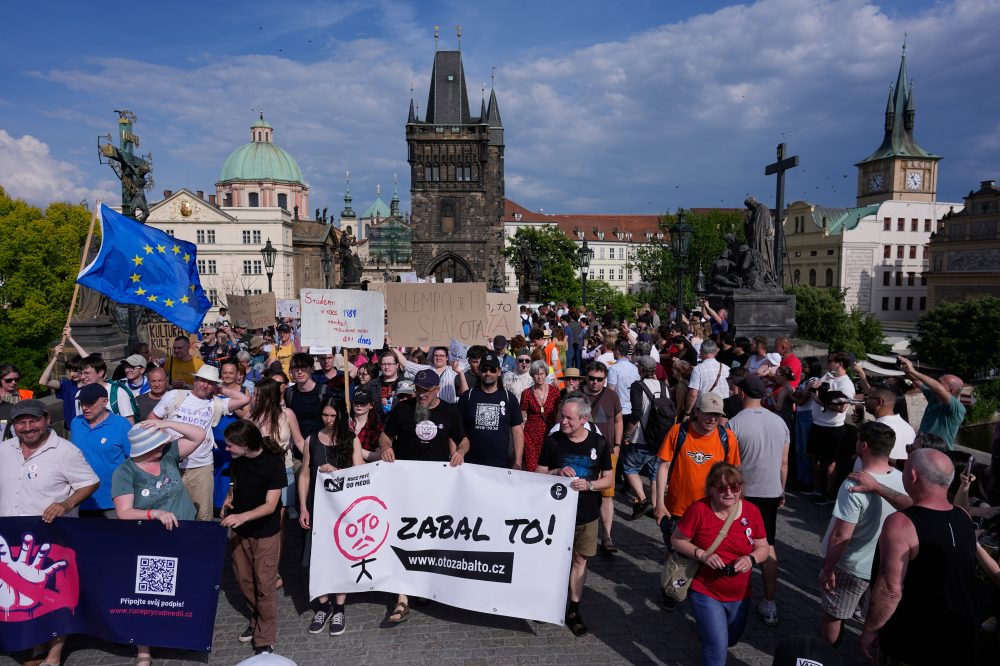

PRAGUE — A large crowd descended on the Czech capital on Sunday to push back against a government proposal that many fear would strip public broadcasters of their independence.
Demonstrators assembled outside the headquarters of Czech public television in Prague to show solidarity with the media. The rally came just one day before broadcast employees were scheduled to stage a warning strike, and followed a series of earlier protest marches held in Prague and other regional cities across the country.
The government, led by populist Prime Minister Andrej Babiš, approved the plan earlier in the week. Under the proposal, public radio and television would begin receiving their funding directly from the state budget starting next year, replacing the current system in which fees collected from individuals, households, and businesses support the broadcasters.
Opponents of the plan argue that shifting to state funding would hand the three-party coalition government a lever of control over the media — drawing comparisons to moves made by populist governments in Slovakia under Prime Minister Robert Fico and Hungary under former Prime Minister Viktor Orbán.
Mikuláš Minář, a lead organizer with the Million Moments for Democracy group, addressed the crowd with a pointed message: “The media don’t belong to politicians. They belong to us all and we won’t allow them to be stolen from us.”
The proposal has drawn criticism from international media organizations as well. Beyond the funding source change, the plan would also cut the broadcasters’ budgets by roughly 15% compared to current levels and includes no guarantees of future financial support.
Leaders of both the public radio and television networks warned that such cuts would force them to eliminate hundreds of positions. Babiš, for his part, argued that the media organizations need to tighten their belts financially.
The record of Babiš, his cabinet members, and allied lawmakers includes a pattern of criticism and attacks directed at public and mainstream media outlets. His coalition’s broader agenda also includes pulling back from support for Ukraine and opposing certain key European Union policies.