
HAVANA — At the Church of the Holy Spirit in Old Havana’s historic district, approximately 50 senior citizens recently gathered for their regular communal meal, sharing ground beef, rice, red beans and crackers with mayonnaise, followed by traditional Cuban coffee.
Before eating, the group recited together: “May the Lord bless from his height, the meal our belly will take with delight,” a prayer they repeat three times weekly in the church’s dining area.
Carmen Casado, an 84-year-old former chemical engineer, never misses these gatherings. Her government retirement check totals 2,000 Cuban pesos monthly — worth approximately $4 when exchanged at the unofficial rates locals rely on daily. Living by herself without children or family support from overseas, she depends heavily on these church dinners.
The meals provide crucial nutrition beyond the limited government rations of bread, rice and beans available at state-operated stores known as bodegas, according to Casado.
“This is a lifeline for us retirees with small pensions,” Casado explained quickly. “What we get from the bodegas alone is not enough.”
Cuba’s aging population faces particularly harsh consequences from the nation’s devastating economic downturn, which has intensified significantly this year after oil restrictions implemented under former U.S. President Donald Trump’s administration.
The majority of these seniors worked in government positions — educators, medical professionals, nurses, technicians, maintenance workers, attorneys — and now receive monthly pensions typically under $10. They must cope with reduced subsidized goods that sustained them for decades, plus isolation as younger generations leave the country.
These individuals witnessed Fidel Castro’s arrival in Havana during their youth and experienced every major historical moment on the island, from the Bay of Pigs attack to the historic 2016 handshake between U.S. President Barack Obama and Raúl Castro.
Today, their dedication to the revolution faces its greatest challenge yet, compelling them to hawk tobacco products on sidewalks, wait in lengthy bread lines, and depend on free food from religious organizations and government facilities.
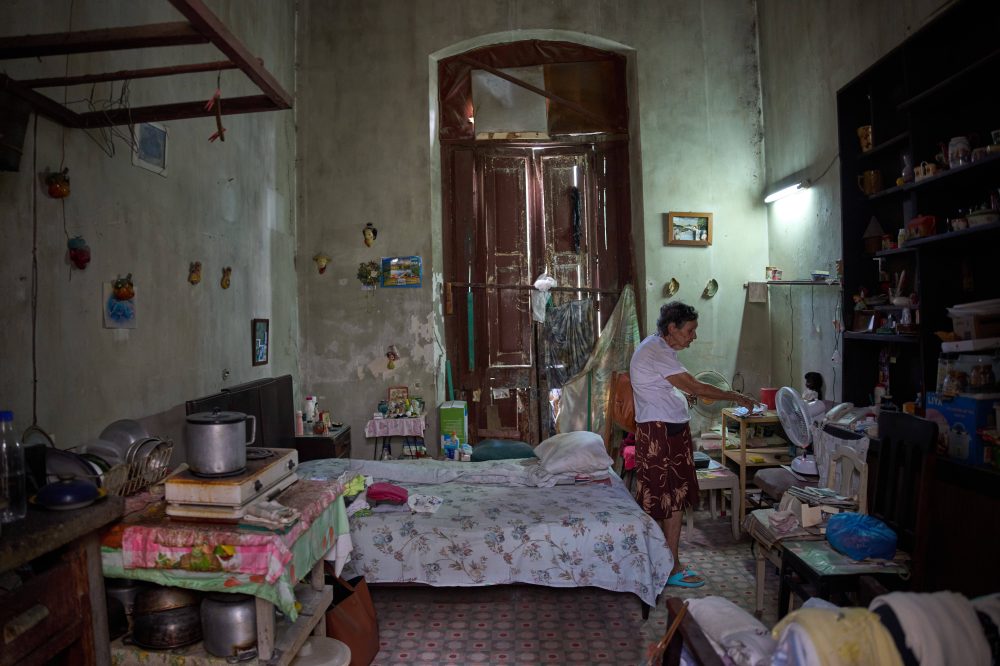
Following her meal, Casado made the four-block journey to her residence, where she continues managing daily tasks independently. She occupies the upper two levels of a deteriorating 19th-century structure typical of many crumbling buildings throughout the capital city.
Born in 1942, Casado came of age during Castro’s revolutionary victory. Her lifetime encompasses the island’s most pivotal events, including the 1962 Cuban Missile Crisis and the economic hardship known as the Special Period after Soviet support ended. She also experienced the prosperous 1970s and 1980s when Soviet assistance funded the economy and Cuba’s socialist system appeared promising.
“This is our life; we were born and raised here,” she reflected.
Before the current economic collapse intensified and recent emigration waves began five years ago, Cuba already ranked among Latin America’s nations with the most elderly residents, driven by extended lifespans and declining birth rates.
Data from Cuba’s National Bureau of Statistics shows nearly 26% of the population reached age 60 or above by late 2024. This figure represents almost double the regional average of 14.2% for the same period, based on information from the Economic Commission for Latin America and the Caribbean (CEPAL).
Over the past five years, Cuba’s population has decreased by nearly 1.5 million people, mainly through emigration. The island’s resident population has dropped from 11.1 million to just 9.7 million currently.
The crisis’s effects and youth exodus are immediately apparent throughout the streets. Elderly residents walk alone — some searching through garbage, others queuing extensively for bread and rice distributed through ration books, the basic subsidized food system the government provides to all Cubans.
The elderly population’s situation has become so dire that authorities recently permitted private business owners to establish elder care services and residential homes, representing a major shift from the island’s traditional complete state oversight model.
Casado maintains she remains fortunate compared to others. She stays mentally alert without physical limitations — not even requiring a walking stick — and handles all personal needs independently. Her sole medication consists of half a blood pressure pill, which remains accessible at government pharmacies “so far.”
Despite experiencing poverty and isolation, she maintains confidence in the government and attributes the nation’s problems to the United States.
“We’re doing everything we can here to move the country forward,” she stated. “But the thing is, we have a very powerful enemy, and he’s right there, right on our doorstep.”