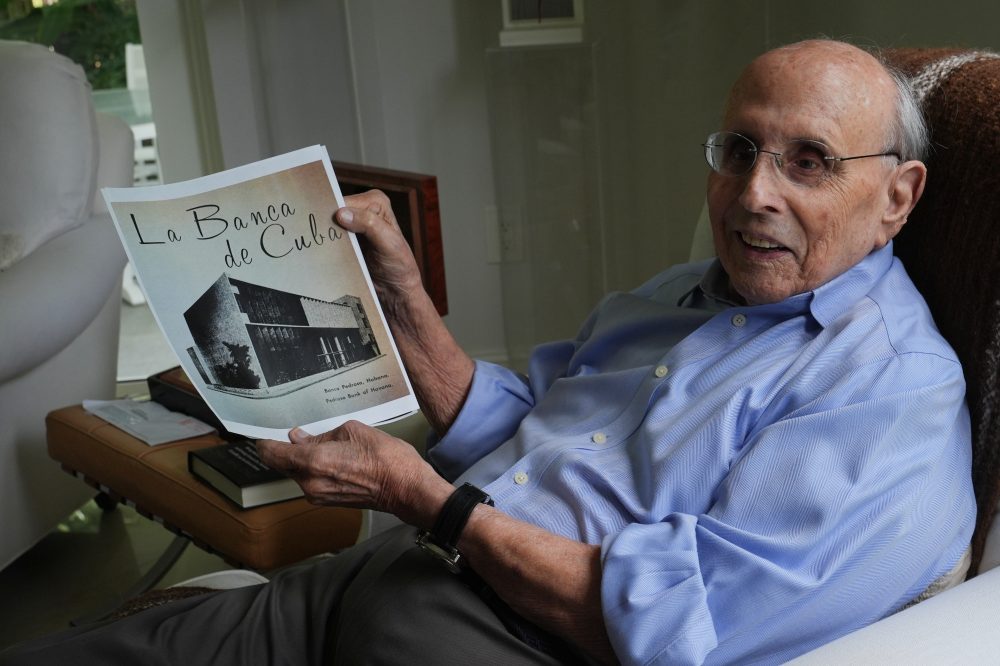

A vivid family memory remains burned into Raul Valdes-Fauli’s mind from November 1960 — the moment an armed revolutionary agent arrived at his family’s Pedroso Bank in Havana with a machine gun and ordered them out.
The agent called his father and uncle “gusanos” — worms, Castro’s derogatory term for those fleeing Cuba — before seizing the financial institution and instantly stripping away property held by a family whose roots in Cuba traced back to 16th-century Spanish settlers.
“They told them this was now the people’s bank,” recalled Valdes-Fauli, a lawyer and former Coral Gables mayor. “They couldn’t even take family pictures off the walls of their office.”
Now, seven decades after such devastating seizures, these painful memories are gaining renewed relevance as President Trump’s military threats and naval blockade of fuel deliveries have crippled Cuba’s struggling economy and triggered talks between Washington and Havana. Numerous Cuban Americans believe 2026 might finally bring the end of communist rule on the island.
Yet this careful optimism among exile communities comes with significant worry about being excluded from any final agreement. Their worst fear centers on a repeat of recent events in Venezuela, where Trump removed Nicolás Maduro but then partnered with his former associates in arrangements that prioritize oil deals over democratic reforms.
“I hope that he doesn’t do what he did in Venezuela, which is keep the thieves in power,” said Valdes-Fauli, whose wife is Venezuelan.
Among the most emotionally charged and complex issues in ongoing discussions involves hundreds of thousands of potential legal claims from Cuban Americans whose properties, enterprises and land were confiscated following Castro’s 1959 takeover.
Nick Gutiérrez’s residence contains yellowing property deeds, vintage photographs and rare publications including a damaged book titled “The Owners of Cuba, 1958” that catalogs the 550 largest fortunes seized by revolutionary forces.
Serving as president of the National Association of Cuban Landowners in Exile, Gutiérrez counsels Cuban exile families on pursuing compensation for forced collectivization. For years this remained an isolated cause pushed to legal margins, since no realistic prospect existed for compelling Cuba to provide payment.
“A lot of it just fell on deaf ears,” Gutiérrez said.
However, with growing speculation about possible governmental change, genuine interest in this matter has surged among those who previously dismissed expensive litigation as futile, along with younger Cuban American business leaders eager to help reconstruct a nation they scarcely know but whose legacy they proudly embrace.
“Now we’re talking about the existential issue of whether the Cuban dictatorship will survive until next month,” said Gutiérrez, whose parents escaped the island two years before his birth.
Resolving property claims in Cuba resembles fighting a many-headed monster, according to Robert Muse, a Washington lawyer specializing in U.S. laws concerning Cuba.
Among property losses, those with strongest legal standing under American law include 5,913 claims certified by the Justice Department in 1972 totaling $1.9 billion. These encompass corporations like ExxonMobil and Marriott International whose holdings were confiscated during Castro’s nationalization campaign affecting everything from petroleum facilities and telecommunications to beauty shops and shoe-shine businesses.
Under American law, these claims — valued at $10 billion currently — must be settled for complete restoration of economic and diplomatic ties. In reality, the executive branch holds authority to take control of private losses through lump-sum payments and incorporate disputes into any Havana settlement.
Breaking from previous positions, Cuba has indicated willingness to address these claims — as part of broader discussions over its demands for compensation regarding damages from the U.S. trade embargo implemented in 1962.
A more complicated matter involves Title III of the 1996 Helms-Burton Act, which permits exiles to file lawsuits against any company considered to be “trafficking” in property seized by Cuba.
Previous U.S. presidents suspended Title III due to objections from American allies conducting Cuban business. Many exiles also viewed this legislation as hollow threats given slim chances of collecting from an insolvent government.
Trump ended the suspension in 2019, leading to approximately 50 filed lawsuits. Additional claims could emerge soon depending on two cases argued before the U.S. Supreme Court this year.
One case, initiated by Exxon, pursues $1 billion from Cuban state entities. The other was filed by Delaware-based Havana Docks against four cruise companies that paid Cuba’s government to dock nearly 1 million tourists at a port it previously operated after President Obama restored diplomatic relations.
Muse compared the legal risks of Cuban business to a “stalactite” built over decades, discouraging investment and political compromise.
“You can’t have a restitution remedy for hundreds of thousands of claimants,” Muse said. “It’s unworkable.”
Nevertheless, if Havana genuinely seeks to attract foreign investment, it has reasons to negotiate deals with Cuban Americans prepared to invest domestically, Gutiérrez noted. A template exists in former Communist Eastern European nations that provided property seizure compensation after the Cold War, helping their economies advance rapidly.
Trump, Muse suggested, may possess the right combination of business acumen, impatience with tradition and political independence as a second-term president to navigate this complicated situation. Evidence that he won’t be hindered by legal disputes, Muse added, came when he hosted oil executives at the White House following Maduro’s removal and instructed them to abandon unpaid claims from Venezuelan asset seizures.
Gutiérrez worries that Trump’s desire for an achievement that has escaped 12 previous Democratic and Republican presidents might overwhelm his judgment. But he finds reassurance in the president’s established relationships with Cuban Americans who rank among his strongest supporters.
“Trump doesn’t have moral qualms of doing business with bad guys,” Gutiérrez said. “But he knows how important this is to us, and that gives us some comfort he won’t sell us out.”