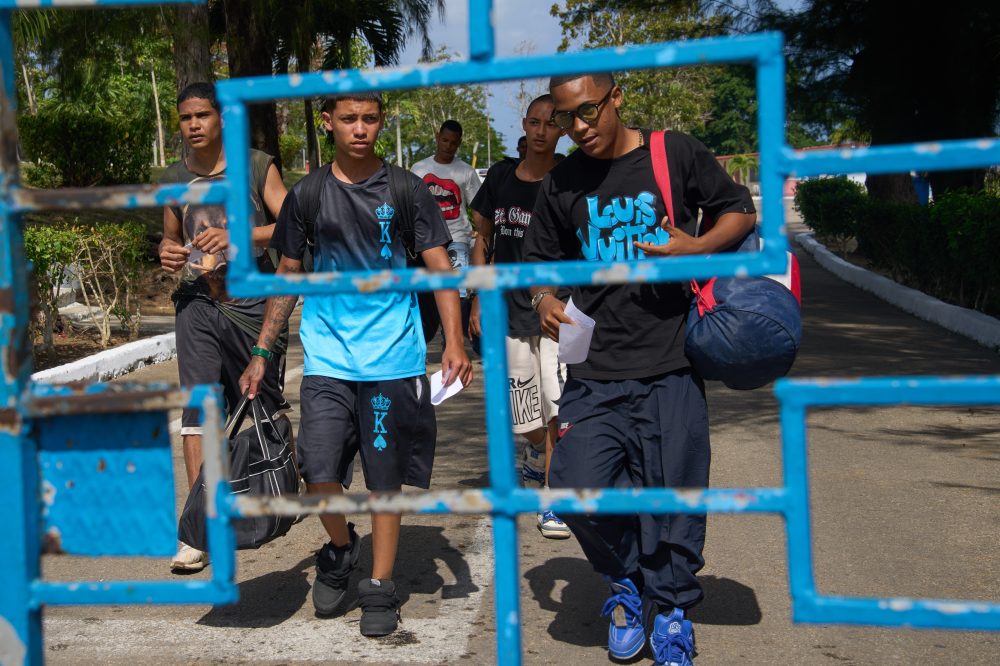

HAVANA — Outside a detention center near Cuba’s capital, 43-year-old Katia Arias felt overwhelming hope Friday morning as she joined other families waiting for one of the largest prisoner releases the Cuban government has conducted in recent years.
Her son, 20-year-old Emilio Alejandro Leyva, emerged from the facility alongside dozens of other inmates, carrying his belongings and release papers after serving time for robbery charges. Mother and son embraced for the first time in years.
“It has been so difficult, but today God has given me so much joy,” said Arias, 43, breaking down in tears. “Today, I feel so happy. This is how all mothers who will have their children released today should feel.”
Families experienced waves of emotion following Thursday’s announcement that Cuban officials would free 2,010 inmates in what they described as “humanitarian gestures” before Holy Week. Officials have not confirmed how many walked free on Friday.
The prisoner release occurs while Cuba faces intense pressure and severe oil restrictions imposed by the Trump administration, which has publicly called for government change and the freedom of detained protesters.
Questions remain about whether Friday’s releases included any of the 1,214 individuals that activist organizations claim are jailed for political activities in Cuba. Cuban officials reject claims they hold political prisoners.
At La Lima prison in Havana’s rural outskirts Friday, inmates reported being awakened at 6 a.m. to hear their names announced. Within hours, they were reuniting with family members gathered outside the facility’s blue entrance gates.
Most prisoners who spoke with The Associated Press Friday had not been incarcerated on political charges, though it remains unknown how many released individuals were protesters — typically charged with public disturbance, disrespect, or terrorism. The activist group Prisoners Defended has documented more than one thousand people detained for political reasons, many stemming from the 2021 widespread demonstrations that resulted in mass government arrests.
Recent months have seen scattered protests as the island faces deepening crisis. In March, demonstrators set fire to the communist party building in central Cuba, resulting in five arrests.
Limited information about Friday’s releases sparked frustration among human rights and opposition organizations, who viewed the releases positively but insufficient for meaningful reform.
“The government presents it as a humanitarian gesture toward prisoners, not as the release of political prisoners,” said Manuel Cuesta Morúa, leader of the Council for Democratic Transition in Cuba, the island’s main opposition platform. “By doing so, it mixes things up to avoid giving the impression that it recognizes political imprisonment in Cuba.”
The organization has called for official amnesty legislation and notes that previously released individuals often face house arrest or restrictions on free speech.
In a March release of 51 people, prison monitoring groups identified political motivations in 22 cases.
The advocacy organization Justicia 11J stated Friday that partial releases cannot represent progress “as long as the criminalization of the exercise of fundamental rights persists.”
“Although every release represents immediate relief, especially for families, in a context marked by the severity of conditions in the country’s prisons … we warn that this gesture does not constitute a change in the repressive policy of the Cuban state,” the organization said.
These releases coincide with escalating U.S.-Cuban tensions. Trump administration policies have strangled the island through oil restrictions, pushing the already struggling nation toward collapse, devastating hospitals and increasing nationwide power outages.
Cubans received temporary relief this week when President Trump announced the government permitted a Russian vessel carrying nine to ten days’ worth of fuel to reach the island. Whether Cuban or Russian officials made concessions for the shipment remains unclear. Another Russian tanker is en route.
Cuba routinely releases prisoners during significant periods.
In January 2025, Cuban authorities freed 553 inmates as part of Vatican negotiations, one day after the Biden administration announced plans to remove the island’s state sponsor of terrorism designation.
Cuban officials stated Friday’s release represents the fifth since 2011, with more than 11,000 people freed overall.
Despite continuing uncertainty, hopeful scenes unfolded outside La Lima prison Friday as families embraced and a father kissed his pink-wrapped infant’s head.
Twenty-year-old Damián Fariñas, who completed most of his two-year robbery sentence, met three excited friends waiting on the street.
“This is freedom, a pardon, owing nothing to anyone. I’m heading out into the world,” he said.