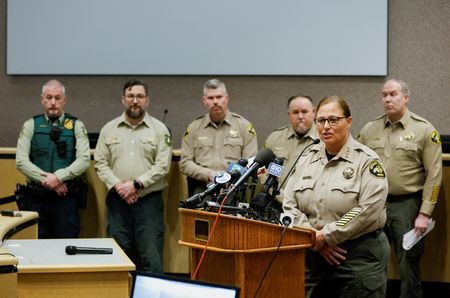

Nevada County Sheriff’s officials announced Thursday they are examining whether criminal negligence may have contributed to a devastating avalanche that claimed the lives of at least eight people during a guided backcountry skiing expedition in California’s Sierra Nevada mountains.
Law enforcement emphasized that the investigation remains in its early phases, with no specific individuals yet targeted for potential charges. The Nevada County Sheriff’s Office stated in a written release: “in addition to the coroner’s death investigations, the Nevada County Sheriff’s Office is also conducting a parallel investigation into whether criminal negligence was involved.”
Officials cautioned that determining whether charges are appropriate is premature at this stage. The Nevada County District Attorney’s Office, which would make any charging decisions, has refused to provide comment on the matter.
The deadly slide occurred Tuesday when a massive avalanche, roughly the size of a football field, engulfed a group of skiers during their final day of a three-day wilderness expedition led by Blackbird Mountain Guides. Nine people are believed to have perished in what represents the most fatal U.S. avalanche in nearly half a century.
The skiing party consisted of 15 individuals, including four professional guides from Blackbird. The group was making their way back to a trailhead through heavy snowfall when disaster struck. Three of the company’s guides were among the fatalities.
Rescue teams successfully extracted six survivors from the remote Castle Peak region near Truckee, California, located roughly 10 miles northwest of Lake Tahoe.
Blackbird Mountain Guides, established in 2020 and specializing in guided skiing expeditions, alpine climbing adventures, and avalanche safety training, has not responded to requests for comment.
Company founder Zeb Blais issued a statement late Wednesday expressing grief over the tragedy. He emphasized that all guides participating in the trip possessed extensive backcountry skiing expertise, with each serving as an instructor for the Colorado-based American Institute for Avalanche Research and Education.
“There is still a lot we’re learning about what happened,” Blais stated. “It’s too soon to draw conclusions, but investigations are underway.”
Blais continued: “We ask that people following this tragedy refrain from speculating. We don’t have all the answers yet, and it may be some time before we do.”
Prior to the incident, avalanche warning centers had issued alerts about extremely hazardous conditions following a major winter storm that deposited substantial snowfall on mountains that had experienced minimal snow accumulation in preceding months. Specialists cautioned that the fragile foundation of existing snow would likely fail under the weight of the newly fallen heavy, compact snow layer, creating elevated avalanche danger.
The Blackbird expedition, comprising nine women and six men, had been lodging at the Frog Lake Backcountry Huts near Donner Summit northwest of Truckee, situated at approximately 7,500 feet above sea level. Beyond California operations, Blackbird conducts backcountry tours in Washington state and British Columbia, along with other skiing locations.
Frank Carus, who directs the Bridger-Teton National Forest Avalanche Center in Wyoming and formerly worked as a backcountry ski guide, advised against premature conclusions about responsibility until investigation results are available.
“The main thing here is not to rush to judgment,” Carus explained, noting his experience investigating fatal avalanches and describing such inquiries as extremely complex processes requiring several weeks to complete. “The worst thing to do is to blame or shame before the facts are known.”
Carus praised the training credentials of the Blackbird Mountain guides involved in the fatal avalanche, calling their preparation the industry’s highest standard.
“These were people tested on their ability to manage clients in the terrain and manage exposure risk,” Carus noted.
The surviving skiers created an emergency shelter using tarpaulin materials following the avalanche and utilized emergency beacons and text messages to relay their position to rescue personnel.