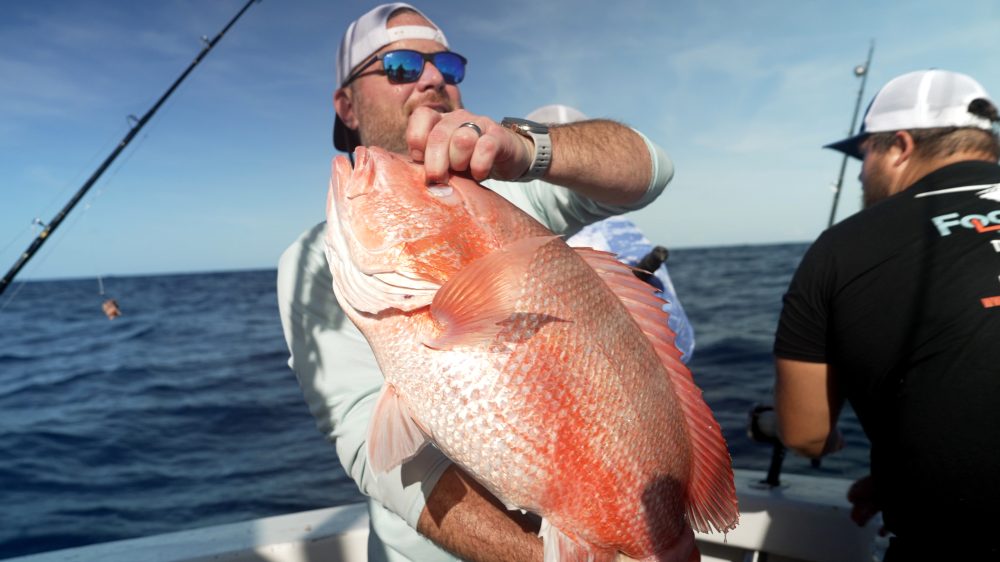

ST. AUGUSTINE, Fla. (AP) — Far from the coastline, Chris Kemp battles with his fishing rod as he works to reel in a catch from 150 feet beneath the surface. After a lengthy struggle, he successfully brings aboard a 10-pound red snapper onto the charter vessel Jodie Lynn II.
His celebration is short-lived. While Kemp holds up his catch for a photograph, the boat’s captain quickly approaches and pierces the fish’s air-filled swim bladder with a sharp instrument. This federally mandated process aims to increase the fish’s survival odds when returned to the water.
“Throw it back,” the captain commands. With those words, Kemp’s dream of taking his prize home for dinner vanishes.
Sport fishermen such as Kemp find themselves in opposition to commercial fishing interests and conservation groups in a court battle that stopped what should have been the most extended snapper season in recent memory. This conflict highlights wider disagreements surrounding the administration’s push to relax fishing regulations and reduce ocean oversight.
In support of these deregulation goals, the National Oceanic and Atmospheric Administration granted states relief from certain restrictions under the Magnuson-Stevens Act, the key legislation governing fisheries oversight, back in May. However, a federal judge in Washington prevented this decision from taking effect by issuing a court order blocking the plan.
The Atlantic red snapper has earned recognition for its fierce resistance when hooked and its appeal as table fare. Following years of excessive harvesting, authorities implemented strict recreational fishing limits in 2010, restricting access to just a few days annually or banning it entirely.
Beginning the previous year, the governor led an initiative alongside officials from Georgia, North Carolina and South Carolina to assume control over recreational Atlantic snapper management, describing the effort as protecting anglers’ “God-given right to fish.”
In May, NOAA granted special authorization releasing the states from certain legal obligations regarding fish protection. Rather than implementing complete fishing prohibitions on bottom fishing during winter months, as NOAA had suggested the prior year, the agency established an Atlantic snapper season across four states lasting between 39 and 62 days, permitting anglers to retain one fish daily.
“We were excited,” Kemp stated, explaining he had scheduled a charter trip to align with the season’s first day.
The dispute reached federal court just prior to the May 22 season launch, and U.S. District Judge Rudolph Contreras granted an injunction partly due to environmental considerations. His decision referenced projections from the nonprofit Ocean Conservancy indicating recreational catches might total up to 485,000 in Florida alone during the extended season — twenty times the permitted landed catch quota.
Kemp discovered the judge’s ruling through a text from a friend while traveling to the marina.
“Originally we thought it was a joke, given the severity,” Kemp remarked.
The decision triggered immediate criticism. State wildlife authorities condemned the ruling as the action of a “rogue federal judge,” while some fishermen named in the lawsuit received threats after the governor incorrectly claimed they sought to monopolize the quota for their own benefit.
Among the plaintiffs, North Carolina fisherman Jeff Oden explained that commercial fishing operations face difficult conditions due to increased expenses and competition from foreign seafood imports. He expressed concern that expanded recreational harvesting might reduce snapper availability when the commercial season opens later this year.
“We’re vanishing,” Oden stated. “You as a consumer, you’re the loser.”
The disagreement partially originates from differing views on the fishery’s condition. NOAA calculates that approximately 25% of released red snapper perish, despite survival-enhancing methods like bladder puncturing to release gases that accumulate when fish are brought up from deep waters, preventing their return to their natural habitat.
Many fishermen maintain the population is healthy. Kemp’s party caught roughly twelve fish in just 40 minutes after reaching a reef off the coast.
“To be completely honest, we have never seen an unhealthy stock,” said Haley Stephens, who operates the charter boat Sea Spirit with her husband in Ponce Inlet.
Researchers argue that the prevalence of juvenile fish creates false impressions and reference biological studies showing most caught fish haven’t achieved full reproductive capability.
“It’s tricky because this is a rebuilding fish stock,” explained Meredith Moore, a program director at Ocean Conservancy. “So people out in the water are seeing more of the fish than they have seen in a long time, and so that gives them the sense that everything is great.”
NOAA refused to discuss the snapper controversy, referencing active legal proceedings. The agency noted it collaborates with fisheries administrators nationwide “to better prioritize work around existing resources, explore efficiencies, and streamline operations” following the “Restoring American Seafood Competitiveness” executive order signed by the president last year.
In his decision, the judge criticized the states for refusing to supply their own catch estimates. State representatives countered that current federal projections were unreliable and would eventually be replaced with enhanced state-gathered information.
Oden acknowledged recreational fishermen’s frustrations but insisted everyone must participate in conservation efforts.
“There’s only so many fish to go around,” he concluded.