
Myanmar’s military has dramatically stepped up violence against civilians since the country’s new administration came to power, according to a conflict monitoring organization — even as neighboring nations ramp up diplomatic efforts with the regime.
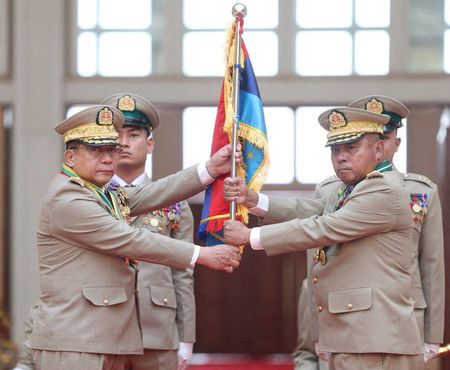
The Armed Conflict Location & Event Data Project, known as ACLED, attributed the surge in violence to tactics introduced by Myanmar’s new military chief, who assumed command in late March as his predecessor prepared to take over as the country’s president.
“Since the ruling junta in Myanmar reconfigured its military command structure in March, civilians have been subject to the military’s worsening repression and intensified aerial bombing campaign,” ACLED stated.
The organization added: “These adjustments included the regular deployment of specialised groups of two to five jet fighters executing sustained airstrikes against single targets.”
A spokesperson for the Myanmar government did not respond to Reuters’ request for comment.
ACLED collects conflict data from media coverage, local partners, United Nations reports, international monitoring organizations, and local human rights groups.
The country has been engulfed in chaos since the military removed Aung San Suu Kyi’s democratically elected government in February 2021, triggering a civil war that has claimed roughly 100,000 lives and forced millions from their homes.
Shortly before assuming the presidency following an election that excluded most opposition candidates, Min Aung Hlaing named a longtime loyalist and former intelligence chief, Ye Win Oo, as the military’s new commander-in-chief.
Under Ye Win Oo’s command, the military has launched fresh offensives into multiple border regions, including areas containing significant rare earth mineral deposits and key trade corridors.
“Reprieve for civilians is unlikely as the junta focuses its efforts on consolidating control following coup leader Min Aung Hlaing’s transition from commander of the military to civilian president in April,” ACLED warned.
During the first six months of 2026, ACLED documented more than a dozen mass killings that resulted in over 450 civilian deaths. Roughly 40 percent of those fatalities occurred in Myanmar’s central dry zone, known as the Anyar region.
In May, hundreds of military troops swept through sections of Myit Chay township — located across the river from the ancient temples of Bagan — killing at least 40 people, according to three local residents who spoke with Reuters.
“About 700 soldiers came into the town, grabbed the belongings of the people here and then beat them and killed them,” said Ye Naung, 35, a resident of the area.
Reuters was unable to independently confirm the events at Myit Chay, though the incident appears in ACLED’s event database with a recorded death toll of at least five, and was also covered by local media outlets.
“The military’s tactics in 2026 so far show merely shifting modalities of civilian repression rather than any reduction in its severity,” ACLED concluded.
The political changes in Myanmar have sparked a wave of diplomatic activity, with Min Aung Hlaing making visits to neighboring countries India and China. There has also been cautious movement toward re-engagement with the 11-member Association of Southeast Asian Nations, a regional bloc that had banned Myanmar’s military rulers from its summits following the 2021 coup.
Min Aung Hlaing is scheduled to make an official visit to Thailand on August 6 and 7 as he seeks greater international legitimacy for his government.