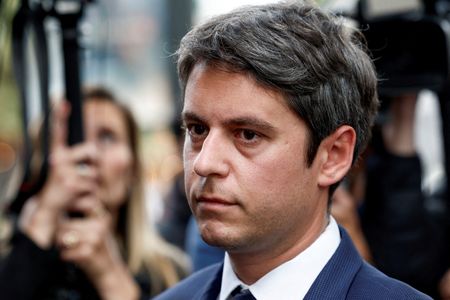

Gabriel Attal, who previously served as France’s prime minister, officially announced his presidential campaign on Friday, adding his name to an already packed list of moderate candidates competing in next year’s election.
The contest to replace President Emmanuel Macron — who is constitutionally barred from seeking another term — appears increasingly divided, with polling data showing the far-right National Rally (RN) holding a commanding position while numerous candidates create the possibility of a final round dominated by political extremes.
At 37 years old, Attal became a household name during Macron’s presidency, though some observers suggest his close association with the unpopular incumbent could hurt his chances. He must also persuade fellow moderate candidates that he represents their strongest option against extremist opponents from both sides of the political spectrum.
During remarks delivered in the town square of Mur-de-Barrez, a small community in central France, following conversations with residents, Attal expressed an upbeat vision for the country’s future, vowing to transform France into “the leading European power.”
“I’ve had enough of French politics being about 50 shades of managing decline,” he declared to journalists. “So because I love France with a passion and love the French passionately, I’m a candidate for the presidency.”
Attal’s political ascent was swift, earning widespread recognition as the government’s spokesperson throughout the COVID-19 crisis before being appointed as the nation’s youngest-ever prime minister.
His time in the top government role lasted only seven months, ending suddenly when Macron decided to call an unexpected parliamentary election — a move Attal had advised against — creating tension between the two leaders.
Following his departure from the prime minister’s office, Attal assumed control of Macron’s Renaissance party, positioning himself to leverage the organization’s substantial financial resources and established infrastructure for a nationwide presidential campaign.
His primary challenge within the moderate coalition comes from Edouard Philippe, another former prime minister who has spent months establishing himself as the centrist movement’s leading figure.
Recent polling indicates Attal could capture up to 14% of first-round votes, while Philippe appears capable of securing as much as 25%. Current survey data suggests Philippe, who serves as mayor of Le Havre, holds the strongest position among moderate candidates to challenge the RN.
The central concern for moderate politicians is the risk of vote splitting. A fractured center could create opportunities for far-right and far-left candidates to advance to the decisive second round of next year’s presidential election.
Numerous figures within France’s political establishment worry about a final round featuring far-right leaders Jordan Bardella or Marine Le Pen facing off against hard-left politician Jean-Luc Mélenchon.
Earlier this month, Attal revealed he had discussed this potential scenario with Philippe, and both men have established a process to determine by early 2027 which candidate is better positioned to unify centrist supporters, with the possibility that one might withdraw from the race.
The two candidates present markedly different approaches to campaigning.
Philippe has maintained a reserved, almost severe public presence since announcing his candidacy, keeping his private life away from media attention. Attal has chosen the opposite strategy, embracing a more intimate and highly visible campaign style.
He has traveled extensively throughout France while promoting his autobiography, which explores his childhood experiences, his father’s death, being targeted for bullying due to his sexual orientation, and his romantic relationship with European Commissioner Stéphane Séjourné, his partner.
Although Attal began his political career within the Socialist party, he has developed his public image by supporting stricter approaches to criminal justice and immigration policy.
While serving as education minister, he gained national recognition by prohibiting abayas — loose-fitting, full-length robes worn by some Muslim women — in schools, citing France’s commitment to secularism.