
Chinese telecommunications giant Huawei Technologies announced modest annual revenue growth on Tuesday, with 2025 sales climbing 2.2% as the company’s core infrastructure and consumer device divisions helped offset declines in cloud computing.
The Shenzhen-based technology firm generated 880.9 billion yuan ($127.5 billion) in total revenue for 2025, representing a significant deceleration from the 22.4% growth rate achieved in 2024.
This year’s financial performance represents Huawei’s second-best revenue showing on record, though still falling short of the company’s peak 891 billion yuan in sales recorded in 2020. Net earnings climbed 8.6% to reach 68 billion yuan.
The technology company’s mobile phone division experienced severe setbacks following US trade sanctions that limited access to cutting-edge semiconductor technology and Google’s Android platform, causing overall revenues to plummet 29% in 2021. The 2025 results mark four straight years of recovery since that low point.
Sales from Huawei’s consumer division, encompassing smartphones and various digital products, increased 1.6% to 344.5 billion yuan. Meanwhile, the information and communication technology infrastructure segment – the company’s primary revenue source – achieved 2.6% sales growth totaling 375 billion yuan, according to the company’s official statement.
The firm’s cloud computing division, though smaller in scale, reported a 3.5% revenue decrease, reflecting intense competition within China’s saturated market. However, the intelligent automotive solutions unit, which assists traditional car manufacturers in developing connected vehicles, experienced remarkable growth of 72.1% with revenues reaching 45 billion yuan.
Huawei maintained substantial investment in research and development initiatives to counter the impact of continuing US trade restrictions.
Research and development expenditures jumped to 192.3 billion yuan in 2025, accounting for 22% of total annual revenue, as the company poured resources into software development, semiconductor design, and manufacturing equipment to decrease dependence on restricted American technology.
Company chairwoman Meng Wanzhou, who is the daughter of Huawei founder Ren Zhengfei, acknowledged in a statement that the organization faces a future “full of uncertainty,” while committing to further expansion of Huawei’s developer community.
The company’s latest Ascend AI processors, model 950PR, have been engineered for better compatibility with Nvidia’s CUDA software platform and have undergone testing at major Chinese technology companies including ByteDance and Alibaba.
Huawei, which develops both Ascend artificial intelligence chips and Kunpeng central processing units, reported that its Ascend platform attracted over 4 million developers by year-end, while the Kunpeng system reached 3.8 million developers.
“Our computing business continued to seize opportunities in AI,” Meng stated.
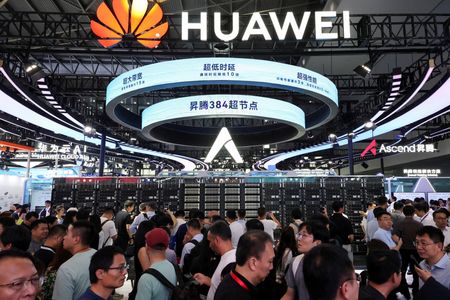
The technology firm noted that its 384 SuperPod artificial intelligence computing platform, launched last year as a competitor to Nvidia’s GB200 NVL 72 system, has secured clients across internet services, financial services, and telecommunications sectors.