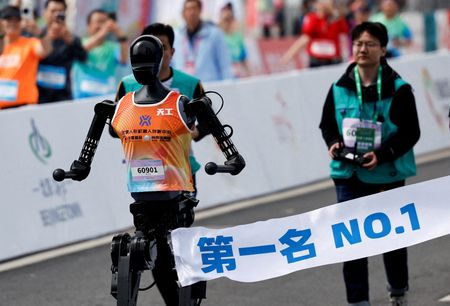

More than 300 humanoid robots will take on a challenging 13-mile course in Beijing this Sunday, marking China’s second annual robot half-marathon as the nation pushes to establish robotics as a cornerstone of its economic future.
The competition has grown dramatically, with over 70 teams participating – nearly five times the number from the previous year. This year’s course features more demanding terrain including paved inclines and parkland areas designed to push the robots’ capabilities to new limits.
“It will certainly be interesting to see the progress in durability of components and battery lifetime compared to last year,” said Georg Stieler, Asia managing director and head of robotics at Stieler, a technology consultancy.
“Humanoid robot makers need to find a balance between quality in products which are still under constant evolution and price pressure.”
The event represents a significant technological milestone. While last year’s competition featured only remote-controlled machines, organizers report that nearly 40% of this year’s robotic participants will complete the course using autonomous navigation systems.
However, the race also exposes the ongoing hurdles Chinese companies encounter as they work to develop robots capable of replicating human movement and performance. Last year’s inaugural event saw several robots tumble and malfunction near the starting area. The champion, the Tiangong Ultra model created by Beijing’s state-supported Innovation Center of Humanoid Robotics working with UBTech, completed the distance in 2 hours and 40 minutes – well ahead of other robotic competitors but more than twice as slow as the human race winner.
This year, the Tiangong Ultra will operate “fully autonomously,” depending entirely on its sensor systems to navigate obstacles and replicate natural human walking patterns through extensive data simulation training, according to the Center of Humanoid Robotics.
“When the robot runs at speeds approaching those of professional human athletes, the time window for perception and decision-making is extremely short, placing very high demands on computing power, algorithms, and system response speed,” the center explained in a statement.
Recent social media footage showing robots training in Beijing at night revealed mixed results. Some models successfully demonstrated human-like running motions and achieved speeds of 14 kilometers per hour, while others displayed awkward, jerky movements and some toppled over or collided with barriers, raising questions about their ability to complete the full race.
China leads the global humanoid robot market, representing more than 80% of the 16,000 units deployed worldwide in 2025, according to Counterpoint Research. In contrast, Tesla, the leading U.S. manufacturer, accounts for just 5% of global humanoid installations.
Chinese market leaders AgiBot and Unitree each delivered more than 5,000 units last year – the highest numbers globally – with Unitree committing to expand its annual production capacity to 75,000 humanoid robots.
Despite the spectacle of the half-marathon, industry experts caution that the demonstrated abilities don’t necessarily translate to widespread commercial use of humanoid robots in industrial environments, where precise manual skills, real-world awareness, and capabilities beyond simple, repetitive tasks are essential.
Currently, Unitree’s humanoid products serve primarily research institutions, dance performances, and interactive guide roles in service businesses, according to the company’s IPO documentation.
Even with some humanoids capable of completing a half-marathon, experts believe widespread household or industrial deployment remains years away, even in China.
“The reason our applications aren’t taking off is that the robots’ IQ is too low. The models are poor, their success rates are low,” said Tang Wenbin, founder of embodied intelligence startup Yuanli Lingji at a Beijing technology conference last month.
“Honestly, the whole industry’s level is still at a very elementary stage … Right now, a lot of what we see is ‘dancing disguised as working’.”
The Chinese government has designated embodied intelligence, or physical AI, as a priority industry for development as it seeks automation solutions to enhance economic productivity and modernize traditional manufacturing.
Chinese robotics companies continue to face challenges in creating the AI software necessary for humanoids to match human factory worker efficiency, while component manufacturers deal with cost pressures, according to industry analysts.
To advance their software capabilities, companies are investing heavily in large-scale real-world data gathering, equipping human workers with sensors and placing more humanoids on factory floors.
UBTech had fewer than 10 humanoids operating in factories in 2024, but that figure surged to over 1,000 last year.
This year, the company plans to deploy 10,000 full-size humanoid robots, including new models designed for various commercial applications, Chief Business Officer Michael Tam announced during a media visit to the company’s Shenzhen facility in southern China.
“When we talk about AI, it relies on how much data, especially high-quality data, we can collect,” he explained.