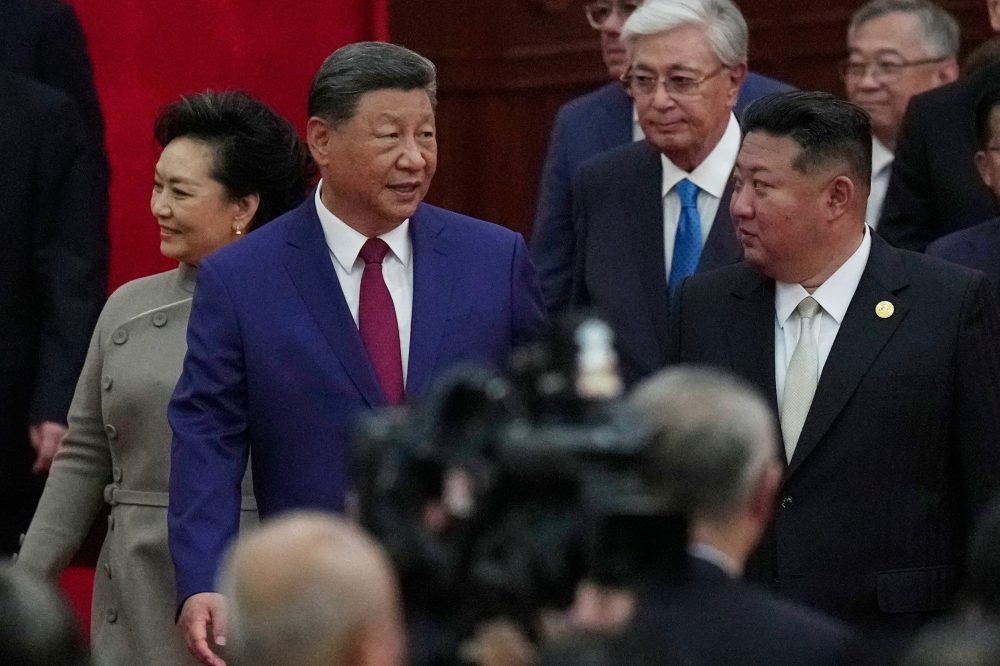

SEOUL, South Korea (AP) — For the first time in almost seven years, China’s Xi Jinping is making a journey to North Korea, providing Kim Jong Un with an opportunity to demonstrate his increasingly bold diplomatic strategy built on strengthening relationships with his nation’s historical Cold War partners.
Beijing, which serves as North Korea’s vital economic lifeline, is looking to reestablish its sway over an allied nation that has recently developed stronger connections with Russia.
This marks the initial face-to-face encounter between the two leaders since Kim made a trip to Beijing for a World War II commemoration in September 2025.
Here’s an examination of what both sides might hope to achieve from their scheduled discussions:
Following years of emphasizing Russia — sending thousands of soldiers and weapons to assist Moscow’s military campaign in Ukraine — North Korea’s leader now wants enhanced relationships with China to further escape international isolation, adopting the concept of a “new Cold War” and positioning Pyongyang as part of a coalition opposing Washington.
Throughout previous leadership periods, North Korea has consistently pursued an “equidistance” strategy with Beijing and Moscow, leveraging its two primary supporters against one another to optimize benefits.
Although Kim is gaining essential support from Russia in return for supporting its military efforts, possibly including defense technologies and assistance, he cannot deliver on his commitment to enhance his people’s quality of life without increased economic help from China, according to Koh Yu-hwan, a former president of Seoul’s Institute of National Unification.
“North Korea vows to maintain a self-reliant economic system and focus on advancing its nuclear capabilities, but in reality it’s nearly impossible to raise living standards by mobilizing internal resources alone,” Koh said.
The discussions between Kim and Xi might cover restarting Chinese tourist visits to North Korea and activating a bridge spanning the Yalu River that has sat dormant for years following its construction, Koh explained. The leaders may also explore collaborative economic development initiatives in border areas shared by North Korea, China and Russia.
Questions remain about whether Kim will eventually leverage his strengthened diplomatic position to restart dialogue with Washington after his negotiations with U.S. President Donald Trump broke down in 2019 due to disputes over sanctions against North Korea.
So far, Pyongyang has rejected Trump’s proposals to restart discussions following the American president’s return to office, demanding that Washington first abandon its requirement for North Korea’s denuclearization as a prerequisite for talks. Kim previously met Xi before his trips to Singapore and Vietnam for his meetings with Trump in 2018 and 2019, actions commonly viewed as attempts to strengthen his negotiating stance. “From North Korea’s perspective, there’s belief that having China’s backing provides a sense of security and confidence when seeking to improve relations with the United States,” said Park Won Gon, a professor at Seoul’s Ewha University.
For China, this visit represents an opportunity to draw a traditional partner back into its sphere of influence by providing potential economic incentives and food assistance, traditional resources it has historically supplied to North Korea.
“I think the Chinese are privately a little uneasy at the embrace of Kim Jong Un and Vladimir Putin, that the North Koreans have really gravitated towards very heavily towards the Russians. Part of Xi Jinping’s goal is to correct the balance,” said Mike Chinoy, a former CNN journalist and author of an upcoming book about the insular country.
Xi is conducting his first international journey in 2026 after becoming more selective about state visits following the pandemic. Following separate meetings with both Trump and Putin, this decision carries strategic significance.
“The trip ensures no one can reshape the peninsula’s security architecture without his concurrence,” Seong-Hyon Lee, a senior fellow at the George H.W. Bush Foundation for U.S.-China Relations, said.
Beijing is also taking a pragmatic approach regarding Kim’s obvious nuclear aspirations.
In April, China’s Foreign Minister Wang Yi traveled to Pyongyang and met with Kim. Analysts highlighted the missing reference to “denuclearization” from the visit’s official statement, a shift from China’s typical position calling for denuclearization of the Korean Peninsula.
“The most telling sign of the visit may be a silence: if China’s official readout omits the word ‘denuclearization,’ Beijing has effectively accepted North Korea as a nuclear state, folding the issue into its broader buffer strategy against the U.S.,” said Lee.
In return, China might pursue expanded access to the Tumen River estuary, which creates part of the boundary between the nations, and navigation privileges in waters near the Korean Peninsula’s eastern coastline.
Ultimately, Kim will likely provide Xi with an elaborate and ceremonial reception on a symbolic level, but China may struggle to gain substantial concessions from an increasingly self-assured Kim, analysts suggest.
“He’s going to give Xi Jinping a welcome befitting of the head of state of their giant neighbor, but he’s not going to play the pliant ‘little brother,’” said Chinoy.